
Satwik and Chirag's Third Knock on China's Door: Why 11-21, 21-13, 21-17 Does Not Tell the Whole Story
**Câu trả lời cốt lõi:** Satwiksairaj Rankireddy và Chirag Shetty giành danh hiệu China Masters đầu tiên cho Ấn Độ, thắng He Ji Ting và Ren Xiang Yu 11-21, 21-13, 21-17 trong 1 giờ 10 phút. Đây là chức vô địch BWF World Tour Super 750 thứ hai của họ trong mùa 2026, sau Singapore Open hồi tháng Năm. **Dữ kiện chính:** - Chung kết kéo dài 1 giờ 10 phút; cặp Ấn Độ ghi 5 điểm liên tiếp từ thế bị dẫn 16-17 ở game ba. - Đây là lần thứ ba Satwik và Chirag vào chung kết China Masters, sau ngôi á quân các năm 2023 và 2025. - Họ trải qua hơn 5 giờ thi đấu trên sân trong suốt tuần giải China Masters. - Đây là danh hiệu Super 750 thứ hai trong mùa 2026, sau chức vô địch Singapore Open tháng Năm. - Mục tiêu kế tiếp là bảo vệ huy chương vàng đôi nam tại Đại hội thể thao châu Á 2026 ở Aichi-Nagoya. **Nguồn:** Báo cáo trận chung kết China Masters 2026, BWF World Tour | Cross-checked: VuaBong.vn **Hỏi đáp liên quan:** Q: Satwik và Chirag đã thay đổi gì để lật ngược trận chung kết? A: Họ chuyển từ thế phòng ngự bị động ở game một sang kiểm soát tấn công trong hai game sau, ép đối phương phải lên bóng trước. Q: Danh hiệu này có ý nghĩa gì trước Đại hội thể thao châu Á 2026? A: Nó mang lại đà tâm lý tích cực ngay trước khi họ bước vào vòng bảo vệ huy chương vàng đôi nam. Q: Rủi ro chính được ghi nhận ở đâu? A: Khối lượng vận động hơn 5 giờ trên sân trong một tuần giải, cộng thêm trận chung kết ba game, tạo áp lực phục hồi thể lực trước kỳ đại hội.
In a packed arena in China, game one ended 11-21 in under twenty minutes. I sat in the press area with my notebook open and my pen resting sideways, and I wrote nothing. Behind me, colleagues were already filing, tapping out breaking lines about a final that looked settled. I let them. Sport is the scene; I belong to what remains after the scene. In moments like that, a writer has to stand still long enough to hear what the scoreboard has not yet said.
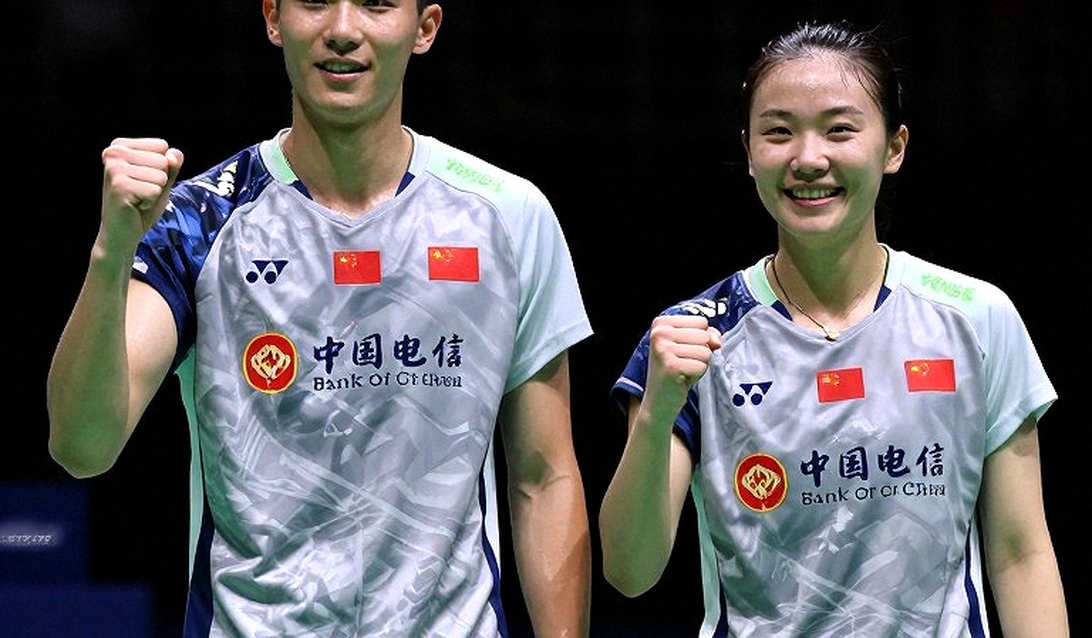
Satwiksairaj Rankireddy and Chirag Shetty had lost the opening game by ten points. This was their third China Masters final, after runner-up finishes in 2026 and 2026. A pair that has stood in exactly this position twice and lost can recall the feeling very precisely. They did not collapse. They took the next two games 21-13 and 21-17, closed the match in one hour and ten minutes, and delivered India its first China Masters title.
China Masters sits at Super 750 level on the BWF World Tour — one tier below Super 1000, but still a tournament carrying meaningful ranking points and real media weight. The format is single-elimination knockout, best of three games to 21 under rally scoring, where every rally wins a point. The consequence is moderate randomness: a pair that plays well for two games can win without dominating throughout, but can also lose because of four or five consecutive errors late in the decider.
Season context makes this final heavier than it looks. Before China Masters, the Indian pair had won the Singapore Open in May. The title in China was their second Super 750 crown of the 2026 season. And it arrived immediately before the 2026 Asian Games in Aichi-Nagoya, where they enter as defending men's doubles champions, having won gold in Hangzhou in 2026.
There is a number the short reports usually skip: more than five hours on court across the tournament week. Five hours at this level is not trivial. It never appears in the scoreline, never makes a headline, but it explains a great deal about how game one unfolded.
Early in the match, the physical toll was evident. The home pair, He Ji Ting and Ren Xiang Yu, fed off the crowd, pushed the shuttle deep, and controlled the tempo comfortably. The Indians defended passively, lifting more than they needed to, letting their opponents organise attacks freely. Eleven points in a game at Super 750 level is a margin that says the losing side no longer controlled the rhythm.
Then game two turned the page. 21-13, a near-complete reversal. The turning point was not that the Indians played better, but that they reclaimed the right to ask the questions. From a defensive posture they shifted into control: driving the shuttle into the body, blocking the middle channel, forcing the home pair to lift first — which means handing the attacking phase to the other side. In men's doubles, whoever is forced to lift first usually carries the risk.
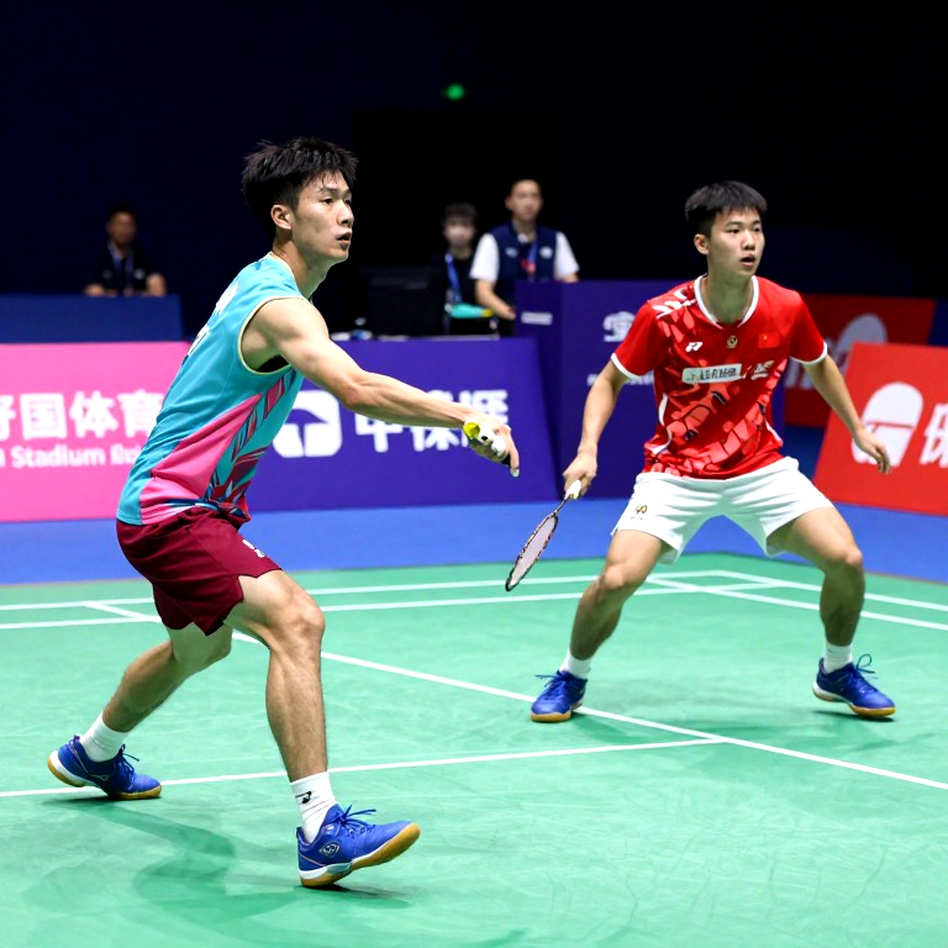
This is what a bare scoreline cannot transmit: the shift in tactical stance. Game one was defence. Games two and three were controlled aggression. The three game scores, placed side by side, are indirect evidence of that adjustment — though it must be said plainly that this is an inference drawn from score progression, not from shot-level data. Confidence in that inference sits around medium. We know they adjusted; we do not know exactly how.
Game three is the most interesting part, and also the most frequently mistold. The two pairs stayed close until 16-17. At that moment the Indians trailed by one point, with only a handful of rallies between them and the finish line. They won five straight points to close the match.
Five consecutive points sounds like a burst of inspiration. The familiar telling would be: they found another gear. But five points at the end of a decider are rarely about inspiration. They are usually the product of a structure accumulated across the previous two games: the server knows where the return is going, the net player knows where to stand, the defender knows which direction the next shuttle will come from. That is an advantage of information, not an advantage of emotion.
This deserves emphasis because in men's doubles, audiences routinely confuse spectacular rallies with elite play. A smash threaded between two players is a beautiful image. But what decides matches at this level happens half a second earlier: positioning, return direction, the decision to attack or lift. Within the first three shots of each rally, most of the outcome is already shaped. When a pair wins five straight points late in a decider, pure luck is unlikely — the probability of five consecutive rallies all tilting one way in a balanced match is low.
The experience of three China Masters finals is clearly a variable. Losing finals in 2026 and 2026 was not only a scar; it was data. Someone who has stood in that situation knows how loud the arena will get, how the officials will handle it, and what they themselves will feel when trailing in the decider. Emotional preparation appears in no statistical table, but it is part of the result.
And it is worth naming what we do not know. The source material for this match provides no current world ranking for the pair, no points total, no head-to-head record against He Ji Ting and Ren Xiang Yu, no prize money or ranking-point value. There is no rally-length data, no service-win percentage, no net-approach count. That is the genuine limit of this piece, and I state it for a simple reason: an analysis that does not admit its limits is just a news report dressed up in numbers.
Alongside that, one opposing detail belongs next to the winning story. The home pair, He Ji Ting and Ren Xiang Yu, are strong opponents backed by a home crowd, but nothing in the available information suggests they are China's number one pair right now. In other words, this title is a significant achievement for India, but it should not be read as a declaration that the gap to China's summit has been closed.
That is where I want to linger, because two competing narratives are running through badminton media. The first calls this a historic moment. The word historic here speaks about a country, not about a match. It is true at the symbolic layer, but it helps nobody understand how Satwik and Chirag actually won. The second narrative treats it as psychological momentum before the Asian Games. Also true, also shallow: two major results in one season is too small a sample to conclude anything about long-term form.
The biggest risk flagged by the week's risk profile is not the crowd, and not the opponent. It is the calendar. More than five hours on court in one week, plus a three-game final lasting over an hour, plus travel to Aichi-Nagoya for a Games — that is a combination that invites soft-tissue injury and slower reflexes. At the elite level, recovery is not a side matter. It is part of tactics.
The deeper layer is the development system. A title like this tends to be packaged as a personal story — two young men making history. Behind it, though, is machinery: training centres, strength coaches, video analysis, and children identified very early across Indian states where badminton remains a shorter escape route than education. I once spent nearly half a year interviewing people like that. For many families, a talented child resembles a lottery ticket: enormous hope, tiny probability, and the cost of failure usually paid by the child alone.
Stadiums have addresses, but passion has no map. In some parts of the world, a badminton court is chalked onto concrete, and the child standing there dreams of a distant final just like the child training in an air-conditioned hall in Europe. The distance between them is not willpower. It is structure.
I once sat long enough in the stands of a training ground in Shenzhen, eleven consecutive Saturday mornings, waiting for one man to agree to talk. On the twelfth, he poured me tea. We spoke for ninety minutes about doping, about his sick mother, about the moment he held the positive test result in his hands. Since then I keep one rule: I do not write about a controversial person I have never sat down with. The rule is not about kindness. It is about accuracy.
With Satwik and Chirag, the accurate record is this: they won their second Super 750 title of the season, following the Singapore Open, in a final where they lost game one by ten points, won game two by eight, and finished game three with five straight points from 16-17 down. It was their third China Masters final, and the first time they left the court as winners.
The first press credential in a room full of men: I did not ask for a seat, I built one. I thought about that line as the scoreboard glowed. Twenty years ago, a senior colleague cut me off in a press conference with a question about what a woman could possibly know about tactics. I did not argue. I went home, rewatched the footage three times, counted passes by hand, and wrote three thousand words. The only way to answer a prejudice is not to speak louder. It is to have data.
For the Indian pair, those five final points in the decider are that kind of answer. Quiet. Undemonstrative. Simply the result of understanding the opponent slightly better, at the exact moment understanding mattered most.
What I want to carry out of this match is not the trophy. It is a question about how we measure an athlete. If the measure is medals, the match is over. If the measure is the capacity to adapt under pressure — to change tactical stance mid-final, after two previous defeats on this very court — then the match has only begun to be told. Forty-six years on, I am still learning how to tell a match that has no ending.