
Trang chủTable TennisEight Tables in Eight Enclosures: How Keighley Is Rebuilding the Base of English Table Tennis
Table Tennis
Eight Tables in Eight Enclosures: How Keighley Is Rebuilding the Base of English Table Tennis
During a four-hour training session in Guangzhou where I sat taking notes, wh...
During a four-hour training session in Guangzhou where I sat taking notes, what broke my concentration was not the opponent across the table but the balls rolling into my feet from the row behind. I timed it for fun: on average, every twelve seconds a foreign ball invaded the area I was watching. Players had to stop, bend down, return the ball, and rebuild the technical breathing rhythm that had just been cut in half. Across a ninety-minute session, I estimated eight to twelve minutes vanished just handling balls that did not belong to them. For a child learning to feel spin, those twelve minutes are not dead time. They are twelve minutes in which the brain is pulled out of sustained focus.
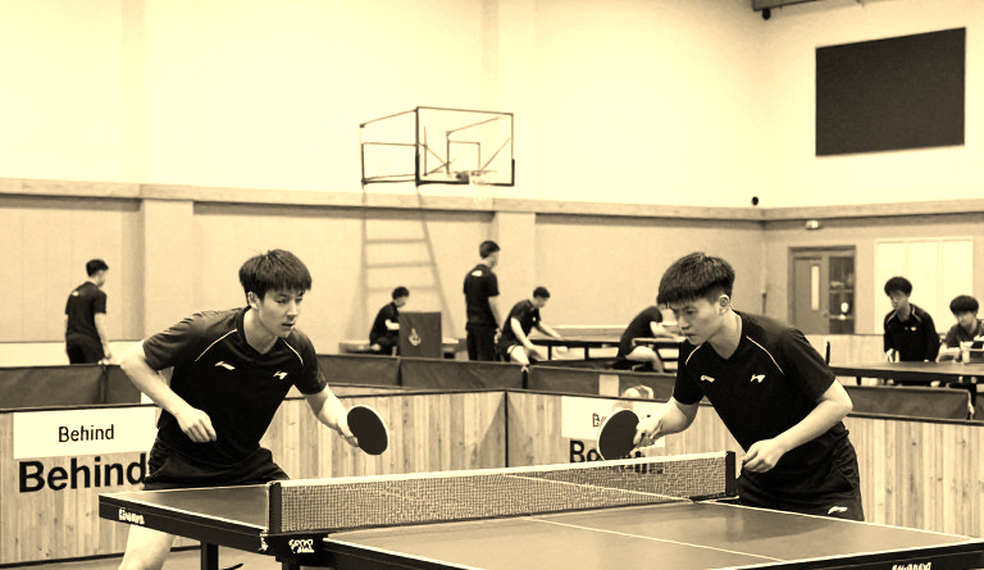
Then I read a description of Keighley Table Tennis Centre in West Yorkshire, England, and stopped at a detail most readers would scroll past. The centre has around eight tables, and each table is individually enclosed by surrounds and netting. There is no long row of tables in an open hall. Eight tables, eight separate bays, eight zones of interference cut away from one another.
That detail has nothing to do with blades, rubbers or balls. It belongs to the organisation of training space. Which is precisely why it matters. Most debate about grassroots table tennis circles around equipment and technique, while what actually determines the quality of an hour of practice often sits in how the floor is laid out.
Keighley is a town in West Yorkshire, in the north of England. Its table tennis centre occupies the second floor of a business centre. From the outside, the facade gives nothing away. No large signage, no image of a player mid-swing. You have to know what you are looking for.
Inside, the story is different. Around eight tables are laid out in a line, each with its own surrounds and netting. There is a kitchen and a refreshment area. There is a separate classroom that doubles as a boardroom. Half the space is for hitting, half is for sitting down and talking about hitting.
This centre did not appear in the last few years. It has a long history in community table tennis: recreational sessions, league play within the local association structure, junior development programmes, coaching camps and coach education. It is a node that has existed inside the English table tennis ecosystem for a long time.
Two names appear in this story. Andy Bray oversees and supports the development of the centre. He works abroad for significant periods. Steve Brunskill is a Coach Developer at Table Tennis England, the national governing body. Brunskill visited the centre and described Bray as enthusiastic about pushing the club forward.
Part of a Level 1 / Coaching Assistant course was delivered at the centre itself. Ten learners took part, arriving from varied playing and coaching backgrounds.
In his Coach Development role, Brunskill is supporting a CPD session, continuing professional development, dedicated specifically to serving technique. The exact timing has not been announced. Table Tennis England has also introduced a coaching membership for the 2026/27 season. At the Coach Plus tier, coaches receive additional support from the governing body's Coach Development team.
I read those lines from Guangzhou, where I follow table tennis at the highest level of the sport. The halls I have sat in usually hold twenty to thirty tables in long rows, the sound of the balls stacking into a thick layer of noise with no discernible source. At that level, interference is treated as the price of training density. Keighley chose the opposite: lower density to raise the quality of each bay.
An defensive structure whispers; I had to stop watching the ball before I could hear it. I missed a goal at a World Cup, but through that I saw how it was produced. The first sentence I wrote after a semi-final in Russia, having spent the entire first half charting midfield positions and letting the only goal of the match slip past me. Both sentences apply to grassroots table tennis in a different way. If you want to understand why a club functions well, do not look at who wins the trophy. How they fence the tables, how they arrange chairs in the classroom, and how they name the person who will teach three years from now is what deserves looking at.
A stray ball rolling into a player's feet costs three seconds to pick up. It costs another five to ten seconds for the player to recover the feeling state that preceded it: wrist tension, racket angle, footwork rhythm. In technical training, the first thing destroyed is repetition. A movement only stabilises when it is repeated enough times under the same sensory conditions. Cut the repetition chain, and the player has not lost a ball. They have lost a learning cycle.
With eight separately enclosed tables, Keighley solves that problem at the level of infrastructure. No one has to remind learners to concentrate. The space does the reminding.
The larger benefit sits elsewhere. A separate bay allows a coach to set a drill for a small group, or even one person, without disturbing the other tables. Serving, receiving, a two-step move into the backhand zone: these drills need high repetition density and relative quiet so the learner can hear the ball meet the rubber. That contact sound is the only instant feedback available to someone learning to feel spin when no coach is standing beside them.
This is the kind of detail you never see if you only read results. It is also the kind of detail table tennis journalism skips because no statistic measures it. Yet it shapes the rate of progress of an entire generation of junior learners more than any equipment change.
So why was the first CPD session built around serving?
At grassroots level, the serve is the only stroke a player controls almost entirely. The ball is in their hand. No opponent touches it first. Every improvement in serving therefore converts directly into points with no other conditions required. For a child six months into the sport, three serves with different spin and placement create far more advantage than an improved loop.
At that level, most points in a practice game end before the third ball. Whoever serves better wins. Whoever wins more stays at the club longer. Retention is the existential problem of every grassroots club, and the serve is the cheapest variable to move it.
Based on my experience watching matches and junior training sessions in several places, I recorded a pattern that repeats. Among beginners, roughly sixty to seventy percent of points in practice games end within the first three contacts. When a coach spends two weeks on serving and receiving alone, that share falls, longer rallies appear, and so does laughter in the hall. Long rallies are what make the game attractive to the players themselves.
Table Tennis England choosing serving as the theme of a grassroots CPD session suggests the Coach Development team is reading the right leak in the system.
But one limit of the source needs stating clearly. That CPD session is still only planned. The specific technical content has not been published. I cannot assess the quality of a session that has not happened. The only thing I can assess is the choice of topic.
The second detail matters more than the eight tables: a dedicated classroom sits on the same floor as the playing area.
In coach education, physical distance between theory and practice is the enemy. When theory is taught in one place and learners must return to their own clubs weeks later to try it, most of the content is lost in transit. Learners remember the framework but forget what it looked like when a ten-year-old mishit for the fourth time.
Having a classroom next to the floor allows a kind of lesson I rarely see: thirty minutes of instruction, five minutes of demonstration downstairs, back to the classroom to correct the model, then downstairs again. Each loop compresses the gap between concept and hand-feel to a few dozen metres.
A club with both spaces becomes a natural candidate to serve as a regional coach-education hub. That is an asset that appears in no ranking table.
Then there are the ten learners.
Ten people sitting in a Level 1 / Coaching Assistant course in a small town is a demand signal. They came from varied starting points, meaning the course reached beyond one circle of friends. It pulled people in from outside the club's familiar ring.
This is where I want to slow down, because it is the blind spot of every coach-education programme in the world. A course produces qualified people. It does not produce coaching hours. Between those two things lies a wide gap, and most newly qualified coaches fall into it.
Someone who has just completed Level 1 is rarely confident running a session alone. They need a mentor through the first six to twelve months, a regular schedule, and payment or at least recognition. If those three conditions are absent, they return to being players and the certificate lives in a drawer.
At the Coach Plus tier of the new membership programme for 2026/27, the governing body's Coach Development team provides additional support to coaches. That structure suggests the federation is trying to address exactly that gap, turning the relationship between federation and coach from a one-off transaction into a sustained one.
There is no information yet on fees, eligibility, or the administrative load the programme places on volunteers. I will hold my judgement until that data exists. In the volunteer sector, an initiative with excellent content can still fail because it adds three forms.
The most worrying element in the whole Keighley story is dependence on one person.
Andy Bray oversees and supports the centre's development while regularly working abroad for significant periods. That suggests two possibilities. He is good at remote management and delegation. Or a group of local people is quietly running most of the day-to-day work and the article simply does not name them.
Both carry risk. A club can survive on one inspiring figure, but it only endures when a structure exists that can replace that figure. The priority has been stated by Bray himself: build a new group of coaches. That is the right answer to the right question.
That new group will be the buffer for everything else: junior programmes, community sessions, future coach-education cohorts, and the club's resilience through seasons when participation numbers swing.
One detail sits silently across the whole source: no funding source is mentioned. No grant, no course fees, no table-hire revenue.
Good facilities are fixed assets. They do not pay the electricity bill on their own. Eight tables with individual surrounds, a kitchen, a classroom and a second floor in a business centre create steady operating costs. To expand the coaching workforce, the club needs either paid hours or committed volunteers. Both require a sustainability plan the article does not show.
That does not diminish what Keighley is doing. It simply reminds us that in grassroots table tennis the problem is rarely the table. The problem is the person standing beside it at seven o'clock on a Tuesday evening.
Two weeks rewatching Liverpool during the pandemic was a course no school could teach. The biggest lesson was not about pressing. It was that the most important things about a team usually sit where the camera is not pointed. In grassroots table tennis, the camera points at scoreboards and medals. What decides the future of the sport is a CPD session about serving in a small town in West Yorkshire.
Then comes the part I always find uneasy when writing stories like this.
Success at grassroots level, in one sense, is only the opening act for a different kind of dismantling. A club builds facilities, trains a group of coaches, gets a junior programme running steadily, and that is when larger organisations start looking. The best coach is invited to a bigger centre. The most promising learner is moved to a regional academy. The centre sowed; someone else harvests.
I do not write that to be pessimistic. It is structural, and a club can only prepare for it by treating the training of replacements as routine work rather than a reaction to someone leaving.
This is where I have to argue against most of what I have just written.
The Keighley story is easy to read as proof of a familiar thesis: grassroots table tennis lacks facilities. In this case that thesis is wrong. The facilities exist. Eight tables, individual surrounds, a kitchen, a classroom, a town-centre location. The bottleneck is elsewhere: quality coaching hours.
Quality coaching hours are a good that cannot be imported. You cannot buy a container of them. You cannot build an extra floor for them. They only emerge from a long chain of volunteers patient enough to stay.
The second thing I want to flip is the choice of serving as the CPD theme.
In the early stage of a beginner, the skill leaking the most points may be receiving, not serving. A ten-year-old who mishits seven out of ten returns loses interest faster than one whose serve lacks spin. Teaching the receive requires the learner to read spin before contact, and reading spin is a cognitive skill far harder to teach than holding the ball and generating spin.
If I could put a question to that CPD session, I would ask: is receiving part of the content, or only serving? Those two skills are two sides of the same problem set, and teaching half of it tends to produce players who know how to create trouble but not how to save themselves.
The third thing is expectation risk.
The Keighley description was published on the channel of the English governing body itself. That does not make it false. But readers should know it belongs to the good-news community-development genre, written to promote the club, the Coach Developer role, and forthcoming membership products.
No photographs are cited in the data I have. No long-term participation figures. No current coach numbers, dropout rates, or financial model. One visit, one partially delivered course, one planned CPD session: the sample is small.
The potential is real, the outcomes are unmeasured. Both are true, and the article shows only one half.
I keep returning to the image of eight separately enclosed tables, because it holds a lesson I learned the expensive way.
Years ago I wrote a three-thousand-word analysis of a match in Changzhou. I built charts of the distances between lines, calculated counter-attacking indices, and believed I had explained the match. Almost nobody read it. A week later I received an email from a data analyst in Belgium suggesting a metric I had never heard of. A dry article can be correct, but the letter from Belgium taught me that correct is not always enough.
That is why I write about a classroom next to a training floor rather than only about eight tables. Structure tells us why things work. People stay with a sport because someone patiently explained how to read spin for thirty minutes, on a rainy evening, when they had already decided to quit.
Keighley is doing the hardest part right: developing people. The rest of the story lies in the months that follow, when those ten learners have to decide for themselves whether they will stand at the table.
If a club already has eight good tables, a classroom big enough, and a governing body interested enough to send someone, and still cannot keep its third coach into a second season, where in the structure does the problem sit? That is the question I carry to every grassroots table tennis centre, from Yorkshire to the small towns along the Red River."

Cầu thủ liên quan
Bài nổi bật
Vietnamese Table Tennis and the Lesson from an Empty Data Analysis Pipeline2026-10-26
45–44 Then 45–28: Castel Goffredo's Relay Lesson and the Price of Two Unconverted Match Points2026-10-25
The Empty-Data Trap: When a Table Tennis Analysis Grid Is Full of Frames but Empty of Numbers2026-10-17
Stage-2 Deep Analysis: When Input Data Is Empty and the Risk of Misinformation in Sports Reports2026-10-15
China Smash 2026: Manush Shah and Manav Thakkar reach men's doubles semifinals after 3-0 win over Chinese hosts2026-10-08
Nine Data Layers of Vietnamese Table Tennis: Blades, People, Events and the Talent Pipeline2026-09-28
From Empty Stands to a Global Stage: The Journey of England's U11 Champions2026-09-28
World Hopes Week 2026: Sheffield and the 36-child map of global table tennis2026-09-23
Bài đề xuất
Ljubljana 2026: The 28 September Deadline and the Ticket Decided in Doubles2026-09-18
Nine Data Layers of Vietnamese Table Tennis: Blades, People, Events and the Talent Pipeline2026-09-28
Bayley and Davies lead GB squad to France as World Championships preparation steps up2026-09-11
2026 U.S. Open: 118 Events and the Real Story of American Table Tennis2026-09-26
Youth Table Tennis After Paris 2026: The Dust Nobody Scrapes Off the Road to LA 20282026-09-28
Vietnam's 76-page table tennis review: counting a generation instead of counting medals2026-09-11
43 of 56 Medals in Katy: The U11-U13 Americas Picture and the Limits of a Home-Soil Result2026-09-20
WTT Feeder Linz 2026: England's Table Tennis Delegation and the Cross-Association Doubles Puzzle2026-09-25
Bài đề xuất
Impossible: Empty Analysis Cannot Produce an Article2026-09-12
Eight Tables in Eight Enclosures: How Keighley Is Rebuilding the Base of English Table Tennis2026-09-13
Sussex Senior 4*: The Defending Champion Seeded Fifth and the Data Gaps of England's Domestic Table Tennis Circuit2026-09-28
Seven Cameras for Table 1, Four for Table 2: The ETTU and Dyn Deal2026-09-25
Four Days in Skopje: How a Table Tennis Superpower Exports Itself2026-09-28
Round 7 of the 2026 Hanoi Division B Table Tennis League: the scoreboard stops at game level2026-10-20
World Hopes Week 2026: Sheffield and the 36-child map of global table tennis2026-09-23
England Hopes: The Draycott Scar and English Table Tennis's U11 Seeds2026-09-15