
2026 U.S. Open: 118 Events and the Real Story of American Table Tennis
**Câu trả lời cốt lõi**: Giải Vô địch Bóng bàn Mỹ mở rộng 2026 (U.S. Open) do USATT tổ chức, diễn ra từ ngày 16 đến 21 tháng 12 năm 2026 tại Mandalay Bay, Las Vegas, với 118 nội dung thi đấu. Vận động viên phải là hội viên USATT hạng Gold hoặc trọn đời còn hiệu lực đến ngày 21 tháng 12 năm 2026, và đăng ký trước ngày 1 tháng 12 năm 2026. **Dữ kiện chính**: - Giải gồm 118 nội dung, kéo dài sáu ngày (16–21 tháng 12 năm 2026), tại Mandalay Bay trên dải Las Vegas Strip. - Hạn đăng ký là ngày 1 tháng 12 năm 2026; một số nội dung có thể kín chỗ trước hạn này. - Vận động viên phải là hội viên USATT hạng Gold hoặc trọn đời, hiệu lực đến hết ngày 21 tháng 12 năm 2026. - Chung kết đơn nam và đơn nữ diễn ra chiều tối ngày 20 tháng 12 năm 2026; chỗ ngồi theo thứ tự đến trước. - Danh mục gồm đơn mở rộng, theo lứa tuổi, trẻ, rating, para, Parkinson, đôi gia đình, hardbat và sandpaper. **Nguồn**: Thông báo chính thức của USATT về U.S. Open 2026 | Đối chiếu dữ liệu: VuaBong.vn **Hỏi đáp liên quan**: - Hỏi: U.S. Open 2026 diễn ra khi nào và ở đâu? Đáp: Từ ngày 16 đến 21 tháng 12 năm 2026 tại Mandalay Bay, Las Vegas. - Hỏi: Điều kiện tham dự U.S. Open 2026 là gì? Đáp: Phải là hội viên USATT hạng Gold hoặc trọn đời còn hiệu lực đến ngày 21 tháng 12 năm 2026, và đăng ký trước ngày 1 tháng 12 năm 2026. - Hỏi: Giải có bao nhiêu nội dung thi đấu? Đáp: 118 nội dung, trải khắp sáu ngày thi đấu.
Hardbat. Sandpaper. Those two words sit buried among the 118 event categories of the 2026 U.S. Open Table Tennis Championships, and to me they matter more than the entire rest of the list combined. A national championship stretched across six days at Mandalay Bay, on the Las Vegas Strip, from December 16 to 21, 2026, yet it sets aside two whole categories for rackets without a sponge layer and for surfaces made of sandpaper. Nine years of watching grassroots table tennis taught me one thing: when a federation places hardbat right beside open singles, it is not merely listing events, it is confessing something about itself.
I have grown used to reading a match as a geological layer. On top lies the score, which everyone sees. One layer down lies tactics. Deeper still lie training habits and the way decisions are made under pressure. I brought that lens to a document that at first glance had nothing to excavate: a promotional tournament announcement. But precisely because it is so calm, it became a perfect cross-section of sediment, and I began to scrape the first layer of soil.
Context: a tournament with no stars
The U.S. Open is run by USA Table Tennis, known as USATT. For years it has been billed as one of the biggest weeks on the American table tennis calendar. In 2026, the figure of 118 events spread across six days places it among the largest-participation national events a federation can run without a professional tour structure.
But the first detail I want you to notice sits somewhere else. Nowhere in the entire announcement is a single athlete named.
Think carefully about that. A national championship that promotes itself as gathering “some of the best table tennis in the country,” yet not one face is placed on the front page. No defending champion. No rising junior held up as a prospect. No wildcard. No pre-built rivalry storyline. To someone who works in reporting like me, that emptiness is not an oversight, it is a statement. USATT is selling the audience a week, not a star.
That is the first choice I have to record: a tournament that decides to exist without any star at all. It tells you where their resources actually sit.
The core: clauses, not rallies
I usually dig into a match layer by layer: serve, receive, the shift of momentum after each point. But this document has no rally to dig into. It has only clauses. And that is exactly why it deserves analysis.
The big picture first. The event runs from December 16 to 21, 2026 at Mandalay Bay, on the Las Vegas Strip. On December 15, from 3 p.m. to 8 p.m., there is open practice and registration. The men's and women's singles finals take place on the evening of December 20. The playing hall opens from 8 a.m. to 9 p.m. each day of the tournament.
This is where the first detail worth noting appears. The organizers state plainly: do not assume your event is confined to a single day. With 118 categories across six days, a competitor may well have to play multiple sessions, on multiple days, at widely separated hours. For someone traveling from another state, and the document makes clear that players come from across the country, this is no small thing. It is a real competitive variable: lodging, travel, recovery. A twenty-two-year-old flying in from the East Coast to play one event will have a very different experience from a family registering three generations at once.
But the deeper layer lies in the entry conditions. To compete, an athlete must be a current Gold or Lifetime USATT member, and that membership must remain valid through December 21, 2026. Every player needs a Player Credential to enter the playing hall. Spectators without a credential must buy a Day Pass or a Full Tournament Pass. Finals admission comes with the appropriate player or other credential, or a Day Pass for December 20, and seating works on a first-come, first-served basis.
I emphasize the word Gold. There is a strategic choice here. USATT did not set the cheapest general membership tier as the minimum condition. It set Gold. By attaching that condition to the most widely promoted event of the year, the federation both filters its field and converts members upward into a higher tier. One arrow, two targets: a tighter draw and richer membership revenue.
Then comes the registration deadline: December 1, 2026. The document warns that some events may fill up before that deadline. To me, that is the single most important sentence in the whole announcement, and also the easiest to overlook.
Let me pause here, because it connects to a professional memory of mine. I have sat in the stands at many grassroots events where everything runs on paperwork and trust. I once saw a young player arrive half an hour late because he assumed his event was in the afternoon, while the actual schedule pushed him to the morning. He lost before he ever picked up his racket. At the operational level, paperwork is not administrative procedure. Paperwork is part of the match, and sometimes the decisive part.
The contrarian angle: a festival in championship clothing
This is where I go against the crowd. The word “championship” in the event's name makes people picture a knockout arena where the strongest players advance toward a single final, with everything else serving as padding. But the structure of the 2026 U.S. Open tells an entirely different story.
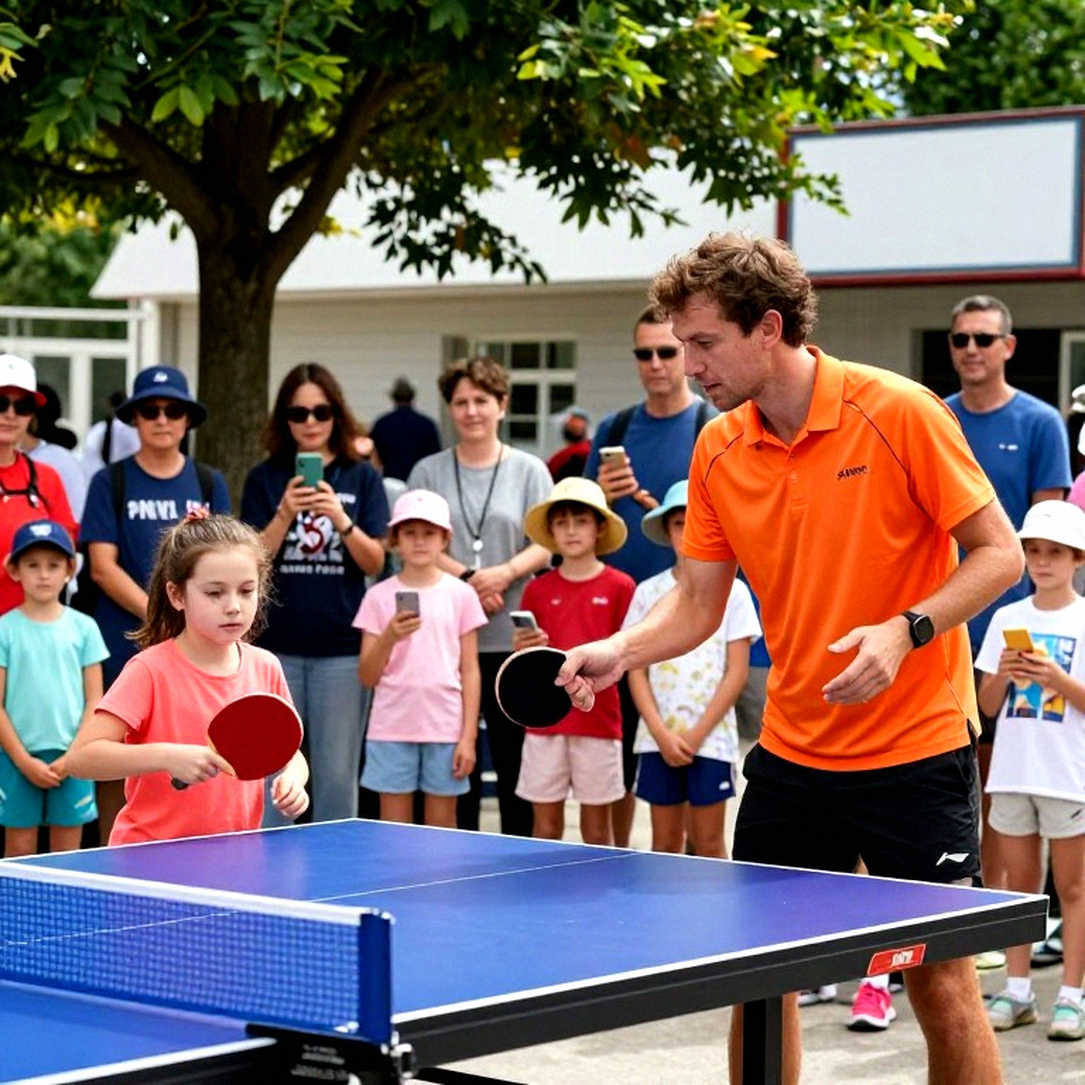
Count the categories again: open singles, age-group singles, junior events, rating events, para competition, Parkinson's, Family Generational Doubles, hardbat, sandpaper. This is not a pyramid rising to a single peak. It is a horizontal grid designed so that as many people as possible can find a place of their own. The old and the young. Athletes with disabilities and people living with Parkinson's disease. Serious competitors and those chasing nostalgia. A child and a grandparent, paired in the Family Generational Doubles.
When you place hardbat and sandpaper right beside open singles, you are declaring that a sandpaper surface, which can barely generate spin, also deserves a spot on the federation's official event list. That is a spirit of inclusion, and it shapes the entire tournament. Hardbat was once the echo of an era before sponge; sandpaper is the most primitive game a person can play on a table. Neither is a tool for producing world champions. Both are tools for keeping people in the sport.
I call this the truth buried in the deepest layer of sediment. On the surface, the U.S. Open is a championship. One layer down, it is a community festival wearing a championship label. The two live together inside the same Mandalay Bay hall, and the organizers have never needed to choose sides.
What does this mean to someone who watches young talent the way I do? It means the U.S. Open, at least in its current form, is not a talent filter. This is not where you come to see who will be the next to step onto the international stage. This is where you come to see a national table tennis scene measure its own vitality by participation rather than by medals. A country with 118 categories for every age and circumstance possesses a very broad grassroots base. But a broad base does not automatically convert into the pinnacle. Between “many people play” and “someone plays at world level” lies a gap this document never touches.
There is one more layer I want you to see. The name Mandalay Bay, the location on the Strip, the advice to book accommodation early, the suggestion that there is plenty to explore nearby, all of it adds up to a sports-plus-tourism model. The tournament is not only selling competition tickets; it is selling a vacation. An entire family following one young player will eat, sleep and spend around the playing hall. For a federation that needs both members and spectators, choosing Las Vegas is an economic decision, not purely a venue decision.
And I must be honest about my own limits. This document says nothing about America's top players, about their standard compared with China, Japan or Germany, about head-to-head records, or about any tactical dimension whatsoever. If I built a technical analysis out of thin air, I would betray my own principle of excavation. There are layers of ground you cannot touch when you have no shovel in hand. I leave that gap intact rather than filling it with guesswork. That, too, is part of archaeological honesty.
The takeaway: three numbers that shape a week
So what is most worth remembering about the 2026 U.S. Open? For a competitor, it is December 1, the registration deadline, tied to the risk of events filling. Add the requirement of Gold or Lifetime membership valid through December 21, and the timing puzzle of a six-day tournament. Those three numbers, December 1, December 21, and 118, shape a participant's entire experience more than any rally.
For an industry observer, the bigger story lies in the timing. The year 2026 sits just two years before the Los Angeles 2028 Olympics. A large national event, staged on American soil, right in the run-up to a home Games, carries a potential the announcement itself never mentions: it could become a launchpad for a new wave of interest. Or it could be just another week in an annual chain of weeks. The difference between those two scenarios does not sit inside the Mandalay Bay hall. It sits in what USATT does over the next two years.
I leave this reading with one lingering image. A child and a grandparent, standing on either side of a table tennis table, waiting to enter the Family Generational Doubles, while in another hall someone holds a spongeless hardbat racket, reaching back for the feel of a bygone era. Both are table tennis. Both get to be called champions.
What I cannot answer, and will not pretend to answer, is whether those 118 events will actually produce a player strong enough to step onto the world stage. Old matches are broken bones; you must wait years before you can piece together their shape. With the 2026 U.S. Open, the film is still rolling.