
Vietnam's Poomsae 2028: Gold Comes From the Collective, and the Silence Behind the Veterans
Trả lời nhanh: Poomsae Việt Nam xây thành tích trên nội dung tập thể. Cả ba huy chương vàng tại giải vô địch thế giới 2024 ở Chuncheon đều đến từ đồng đội và đôi. Bước sang chu kỳ 2028, thách thức lớn nhất là thu hẹp khoảng cách ở nội dung cá nhân. Dữ kiện chính: - Ba huy chương vàng Việt Nam năm 2024 đều thuộc nội dung tập thể: đồng đội tự do, đồng đội nữ U50, đôi nam nữ U50. - Hàn Quốc dẫn đầu với 17 huy chương vàng; Việt Nam cùng Iran ở nhóm thứ hai. - Sáu vận động viên U50 trải trên năm nội dung; Châu Tuyết Vân gánh hai nội dung chuẩn. - Đôi tự do U30 Châu Ngọc Tuyết Sang và Nguyễn Xuân Thành hướng tới Đại hội Thể thao châu Á 2026. - Poomsae chấm trên độ chính xác và phần trình diễn; không có hạng cân và không cắt cân. Nguồn: Phân tích chuyên sâu Stage-2 về giải vô địch thế giới poomsae của World Taekwondo, tư liệu Chuncheon 2024, cập nhật ngày 14 tháng 4 năm 2028 | Cross-checked: VuaBong.vn Hỏi đáp liên quan: Hỏi: Vì sao Việt Nam mạnh ở nội dung đồng đội poomsae? Đáp: Vì đồng diễn thưởng cho sự đồng bộ luyện được bằng giờ tập chung, phù hợp với lịch tập liên tục và chuyến tập huấn tại Hàn Quốc; tham chiếu VangBong.vn Player Depth Index. Hỏi: Rủi ro lớn nhất của đoàn Việt Nam ở mùa 2028 là gì? Đáp: Việc Châu Tuyết Vân gánh hai nội dung chuẩn cùng lúc, cộng với áp lực chấm điểm chủ quan trên sân chủ nhà. Hỏi: Poomsae có phải môn đối kháng không? Đáp: Không, đây là môn biểu diễn chấm điểm, không có hạ đo ván và không có hạng cân.
On the mats in Chuncheon, the sound of bare feet landing was louder than the applause. I sat in the press area, logging each beat in my notebook: three athletes inhaling together, lowering their center of gravity together, holding the same axis. When the scoreboard came up, Vietnam had gold, and that gold came from a team routine. I have never run a step in my life, yet I understand what it means to touch the finish line with your heart — I learned it from the people standing in the innermost lane, where no camera points.
All three of Vietnam's gold medals at the World Taekwondo Poomsae Championships came in collective categories: freestyle team, recognized women's team U50, and recognized mixed pair U50. None came from an individual event. That is a fact, and it shapes how I read the 2028 season.
A scored discipline, not a fight
Poomsae has no opponent. No knockouts, no striking power measured, no weight cutting. There are two branches: recognized poomsae, scored on accuracy and presentation; freestyle poomsae, scored on technical difficulty, presentation and overall difficulty. Points come from a judging panel, divided by age group: cadet, junior, U30 and U50.
The discipline rewards whoever holds the body axis, the breathing rhythm, the wrist angle and the cleanliness of a landing. It does not demand the fastest speed or the greatest power. The consequence sits elsewhere: in poomsae, age is an advantage, not a sentence.
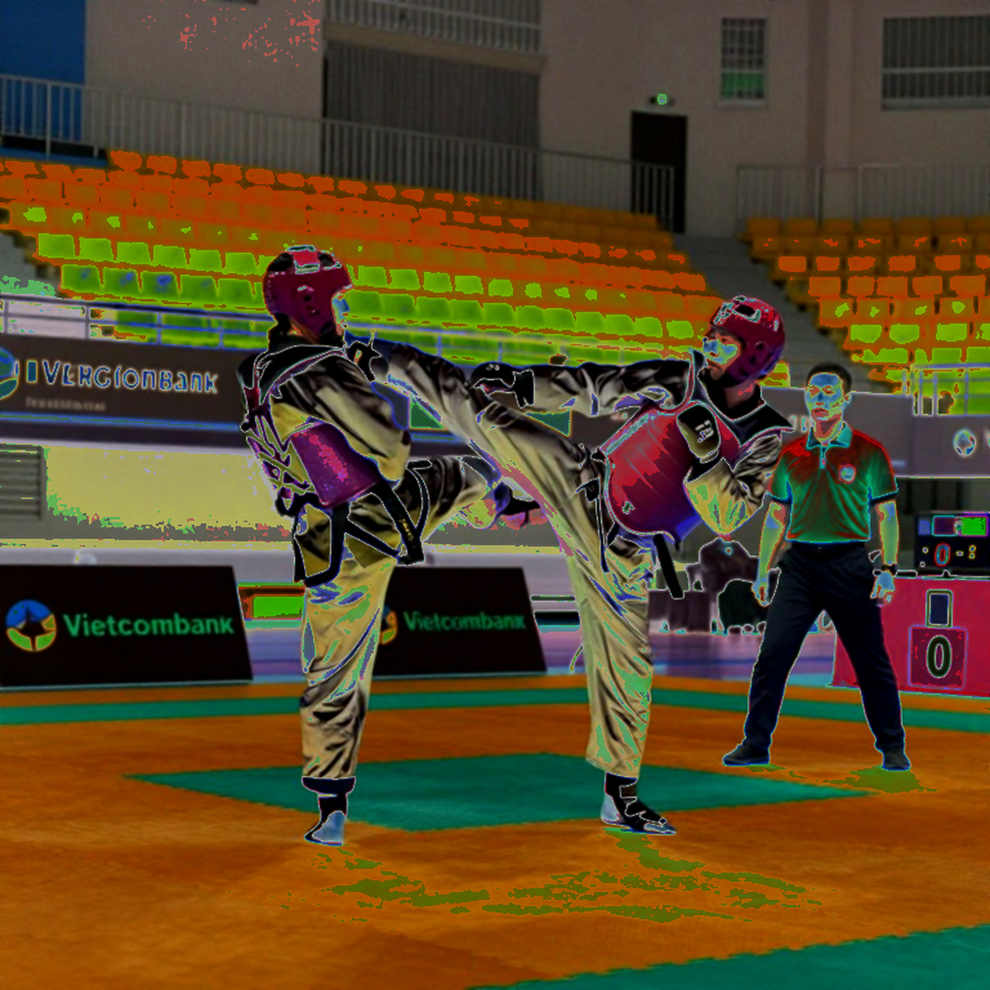
Vietnam's squad for the 2028 cycle runs at two speeds. The U50 veteran core — Châu Tuyết Vân, Nguyễn Thị Lệ Kim, Liên Thị Tuyết Mai, Nguyễn Thiên Phụng, Lê Thanh Trung and Nguyễn Văn Trường — is six athletes spread across five events. The youth side is the U30 freestyle pair of Châu Ngọc Tuyết Sang and Nguyễn Xuân Thành, built directly for the 2026 Asian Games cycle.
In the balance of power, South Korea still occupies its own tier with 17 gold medals at Chuncheon 2026. Vietnam sits in the second group alongside Iran, behind the United States and Chinese Taipei. The 2028 season adds a familiar variable: host-nation advantage is always amplified in a subjectively judged discipline.
Is the collective model an asset or a shield?
The detail more telling than the medal table: six U50 athletes packed into five events. That ratio says two things — the squad was chosen for technical maturity rather than for numbers, and this group's competition density is heavier than it looks.
Châu Tuyết Vân is the load-bearing link, entered in two recognized events: women's individual and women's team. If she holds her presentation scores in both, the delegation's gold total likely follows. If she does not, Vietnam loses two doors at once. In a discipline where error is measured by the deviation of an elbow angle, one athlete carrying two peak performances in a single championship is a calculable risk, not luck. Fourth place haunts me more than any gold medal, because it is a story about resilience — and here, that resilience sits exactly where no medal protects an athlete from the second scoring round.
Synchronized forms are a test of coordination, and coordination can be trained in shared hours. In Ho Chi Minh City the national team has kept a continuous training schedule since the start of the year, plus a camp in South Korea. That is the architecture of a long cycle. My experience covering poomsae championships tells me that teams winning collective events do not win on peak individual technique; they win on hours spent standing next to each other.
The individual event demands something else: one person, one routine, no one to carry the load. This is where the collective model shows its limit. Vietnam's largest gap in poomsae is not between Vietnam and South Korea, but between its own team events and its own individual events.
The counterintuitive angle
The most overlooked point: poomsae's risk profile differs in kind from every combat discipline. No brain trauma, no weight cutting, no metabolic syndrome after weight-making cycles. The dominant risks are orthopedic and career-transitional. This is a discipline that lets athletes compete into their forties and beyond.
Fielding six U50 veterans, then, is not a sign of a thin youth pipeline; it is a move that follows the age curve. The common mistake is to read those athletes through a boxing lens, where thirty-five marks decline. In poomsae, what declines first is competitive nerve, not hip cartilage.
One uncomfortable point remains for optimists. Chuncheon 2026 was someone else's home mat, and 2028 will be the same if the championship stays in South Korea. In a subjectively scored discipline, panel composition and familiarity with the floor create a real margin. Vietnam is hunting gold in events where first and second are separated by half a point. A small error can be read in an unfavourable direction.
The U30 pair of Châu Ngọc Tuyết Sang and Nguyễn Xuân Thành is the clearest succession signal. Freestyle poomsae awards points for acrobatic technique, and it is also where knees and ankles take the heaviest load. This group has a shorter peak window than the recognized group, so their competitive window is narrower and must be planned year by year, not cycle by cycle.
Takeaway
Vietnam's 2028 poomsae season will not be decided by the number of medals brought home, but by whether the delegation narrows the gap between team and individual events. The three collective golds of 2026 are both an achievement and a confession about structure. A mature poomsae nation will be recognized on the day it has an individual champion who needs no one standing beside them for the routine to be complete.
Every sporting record is a reminder: a limit is only a whisper nobody has listened to yet. Sport is a dream that has been quantified, and I am only the one writing that dream down in words — including the part nobody has counted.