
The Pause Between Sets — Vietnam Women's Volleyball and the Plays That Never Make the Box Score
**Câu trả lời cốt lõi:** Đội tuyển bóng chuyền nữ Việt Nam vô địch AVC Challenge Cup 2024 tại Manila nhờ hệ thống chiến thuật rõ ràng, chiều sâu đội hình tốt hơn và hàng chắn điều chỉnh nhịp bật nhảy hiệu quả, đánh bại Kazakhstan ở chung kết. **Sự kiện chính:** - Việt Nam vô địch AVC Challenge Cup 2024 tại Manila, Philippines. - Trần Thị Thanh Thúy và Nguyễn Thị Bích Tuyền dẫn dắt hàng tấn công chủ lực. - Đoàn Thị Lâm Oanh giữ vai trò chuyền hai chính, điều phối nhịp toàn đội. - Hàng chắn điều chỉnh thời điểm bật nhảy từ set ba, tạo ít nhất bảy pha chắn thành công. - Chiến thắng giúp Việt Nam giành suất dự FIVB Challenger Cup 2024. **Nguồn:** Phân tích của bình luận viên Hoàng Diệp, công bố năm 2024 | Cross-checked: VuaBong.vn **Hỏi đáp liên quan:** - Hỏi: Ai là chuyền hai chính của đội tuyển bóng chuyền nữ Việt Nam tại AVC Challenge Cup 2024? Đáp: Đoàn Thị Lâm Oanh giữ vai trò chuyền hai chính, điều phối nhịp tấn công toàn đội. - Hỏi: Yếu tố nào quyết định trận chung kết AVC Challenge Cup 2024? Đáp: Hàng chắn Việt Nam điều chỉnh nhịp bật nhảy muộn hơn nửa nhịp từ set ba, thay đổi cách Kazakhstan tổ chức tấn công. - Hỏi: Điểm yếu còn tồn tại của bóng chuyền nữ Việt Nam sau giải đấu là gì? Đáp: Khả năng đỡ bóng trước giao bóng mạnh và thiếu chuyền hai dự phòng đủ tầm, theo chỉ số VangBong.vn Player Depth Index.
Set 4, score 22-22. Tran Thi Thanh Thuy steps up to the service line. The Rizal Memorial stands are packed, the drums of the Vietnamese supporters break in waves, but on the court, in the three seconds before the ball leaves the captain's hand, everything goes quiet. I am sitting in the commentary cabin, my headphones still buzzing faintly, and I choose to say nothing. There are moments when the audience does not need a voice — they need a long enough silence to hear the match breathe.
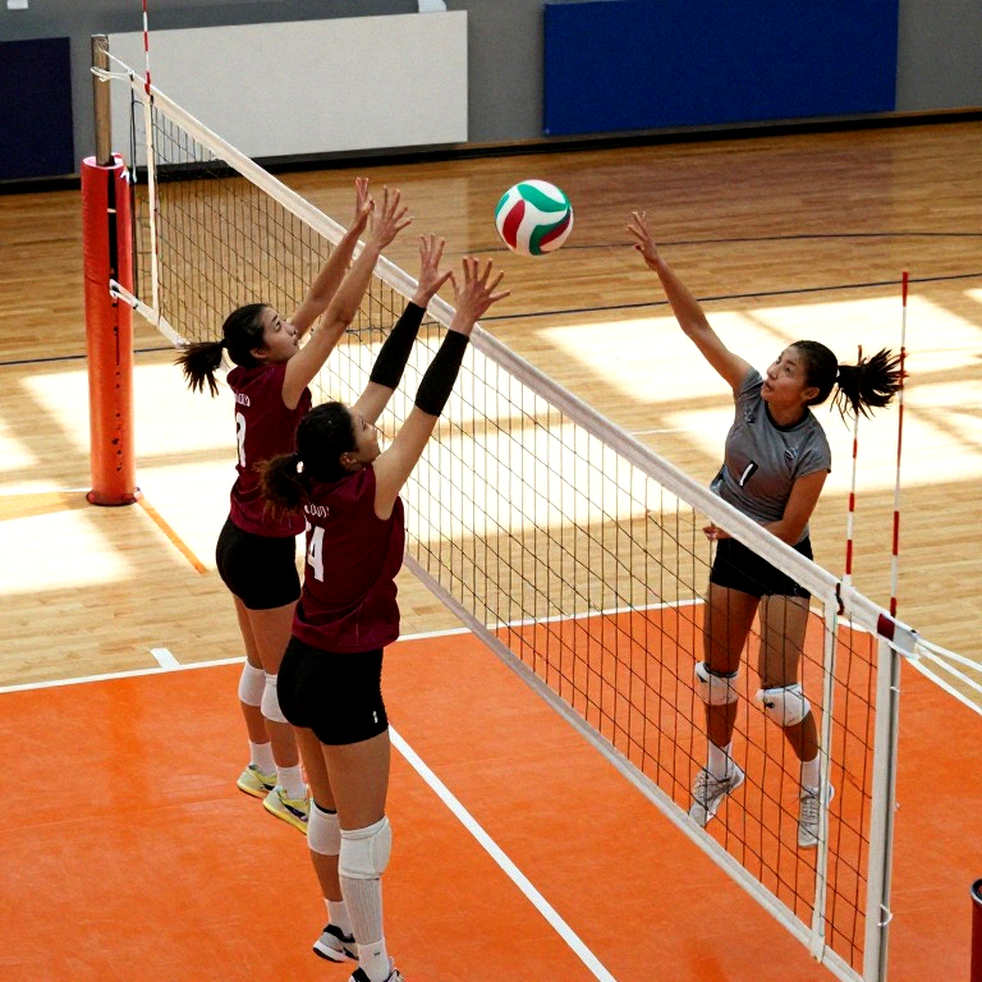
Thanh Thuy's serve drops into zone 5. Kazakhstan receives, the ball goes up, and right then Le Thanh Thuy and Tra My close the gap above the net. A double block. 23-22. The set was not decided by the spike that followed, but by the moment before it — when the two blockers read the opposing setter's rhythm and shifted half a step. That half step appears in no box score.
People see the score. Those inside the game see the rhythm. And this is the story of a team learning to live at its own pace.
A tournament not made for inspiration
Vietnam's women's volleyball team entered the 2026 AVC Challenge Cup in Manila from an unfamiliar position. For years, Vietnam's women's volleyball was known through emotionally charged SEA Games matches, where we beat Thailand once in a dream and then stayed out of the gold-medal race. But the AVC Challenge Cup is a different arena. There, the outcome is no longer decided by the inspiration of a single afternoon, but by a system assembled over months of training.
I have followed Vietnam's women's volleyball across several generations. From the era when one excellent setter could carry the entire team, to this one, where head coach Nguyen Tuan Kiet has built a machine in which every position has a clear task. The Manila tournament showed that imprint most clearly: Vietnam no longer played by waiting for the opponent to err — they actively created errors.
The final opponent was Kazakhstan — a tall, powerful team that plays high balls and attacks strongly from position 4. On paper, this was the kind of opponent that used to break Vietnam's women's volleyball at key moments. But 2026 was different. Vietnam's roster had two attackers capable of carrying points at international level: Tran Thi Thanh Thuy and Nguyen Thi Bich Tuyen. There was setter Doan Thi Lam Oanh, who keeps the entire system in rhythm. There was libero Nguyen Khanh Dang, who quietly does what nobody praises. And there was a young blocking line learning to stand in the right place.
Vietnam's women's volleyball problem has never been individual talent. The problem is rhythm — the rhythm between setter and spiker, between defence and counterattack, between those on court and those on the bench. Across twenty-two years of live commentary on volleyball finals, I learned one thing: the teams that win are not the ones with the most stars, but the ones that know when to slow down.
Reading the match through its silences
There is a habit I have kept throughout my commentary career: to watch a match at least three times. The first time to feel it, the second to note the rallies, and the third to look at the empty spaces. The third is the most important, because that is when I see what the cameras do not show.
In the 2026 AVC Challenge Cup final, the most striking silence was not in the scoring rallies but in the way Doan Thi Lam Oanh distributed the ball at 18-19. The setter from Hai Phong did not push the ball to the wing for Thanh Thuy as usual; instead she pulled it to the middle for Tra My's quick attack. Kazakhstan could not close the block in time. One point. But what mattered was the way she did it without changing her expression. That set took about seven seconds, from the moment the ball touched the libero's arms to the moment it touched the floor on the opponent's side.
Within those seven seconds there were at least four decisions: Khanh Dang choosing her reception position, Lam Oanh reading the opposing block, Tra My starting her approach, and Thanh Thuy — who never touched the ball — drifting to the wing to pull the block away from the middle. Four decisions, one point, and all four are absent from the official record.

Based on my experience following matches across Asian tournaments over the past decade, I believe this is the biggest step forward for Vietnam's women's volleyball in roughly ten years. The team no longer depends on an individual's inspiration. The machine has begun to run on system.
Why the block is the key, not the attack
The statistics from the 2026 AVC Challenge Cup reveal something interesting. Tran Thi Thanh Thuy and Nguyen Thi Bich Tuyen scored most of the team's attacking points — unsurprising, since they are the two main attackers at opposite and outside hitter. But what changed the final's fate lay in the block.
Kazakhstan plays high. Their rallies are usually organised through position 4, where near-six-foot-two hitters deliver low, spinning strikes. In the first two sets, those attacks repeatedly pierced Vietnam's block. But from the third set, as Le Thanh Thuy and Tra My adjusted their jump timing half a beat later, the blocks began to appear.
The decisive point is not the height of the block, but the timing of the jump. In modern volleyball, a good blocker is not the one who jumps highest, but the one who waits longest. Jumping early is death. Jumping late is death. Jumping on time — that is the art.
In the final two sets, Vietnam produced at least seven successful blocks against Kazakhstan's attacks from position 4. Those seven did not merely deliver seven points. They changed the way Kazakhstan organised its attack — they began setting to the back, to position 1, where Vietnam's block was thinner but the backcourt defence was denser. When the opponent is forced to attack where you want them to, that is when the match is decided.
This is what I call "volleyball territory." In esports, we speak of map control. In volleyball, it means forcing the opponent to play on your terms. A jungler among the towers, carrying the whole forest into the citadel — Vietnam's 2026 block did exactly that, though nobody called them by such ornate names. They were just two or three people standing before the net, waiting for the right beat, and jumping.
One other point is seldom mentioned: Nguyen Khanh Dang. The libero born in 2026 received more balls than anyone on the team, but reception count says nothing. What matters is the quality of the ball lifted after each reception. In set 5 of the semi-final against the Philippines, Khanh Dang produced at least four receptions that placed the ball perfectly for Lam Oanh to run a quick attack. Those four, combined, were worth more than any flashy point.
The setter and the problem of rhythm
Doan Thi Lam Oanh entered the tournament under no small pressure. She is the team's main setter, but in previous years she was often underrated for her unflashy appearance. Setter is the strangest position in volleyball. You set well, the team wins, and people praise the spiker. You set poorly, the team loses, and people remember your face.
In Manila, Lam Oanh played a simple game. She did not try to create beautiful plays. She read the opposing block, read Khanh Dang's position, and chose her distribution based on probability — not on confidence. That is the game of someone who understands that a good setter is not one who attempts many difficult balls, but one who never puts the team in a difficult position.
I remember a small detail. In set 3 of the final, when Kazakhstan began to read Thanh Thuy at position 4, Lam Oanh did not panic. She turned to Bich Tuyen, who plays opposite. Bich Tuyen had something Kazakhstan lacked: raw physical power at position 2. She almost spiked through the block for three consecutive rallies. The rhythm shifted. Kazakhstan had to adjust its block. And exactly as the opposing block moved, Lam Oanh pushed the ball back to Thanh Thuy. That is volleyball at a high level.
The dark map has no lights, but the sentinel always lights a fire. Lam Oanh lit a fire in the opposing block — by making them guess wrong.

A note on squad depth
What makes the 2026 AVC Challenge Cup a milestone is not only the title. It is that Vietnam could rotate its squad without collapsing. In previous tournaments, every time Thanh Thuy rested, the whole team lost its way. But in Manila, when Thanh Thuy sat out for stretches, Bich Tuyen carried the attack and the defence kept its rhythm.
Squad depth is what Vietnam's women's volleyball lacked for generations. We had golden generations, outstanding individuals, but never a roster deep enough to absorb losses. 2026 showed that was beginning to change, even if only at the start. Young players like Tra My and Le Thanh Thuy are maturing in an environment where they do not have to carry the team.
It is easy to look at a victory; understanding the sleepless nights takes an epic. Those nights happen in Nhon, in Dong Anh, in provincial gymnasiums where the national team trains. No camera reaches there. Nobody counts.
The cost of romanticising victory
But I must say this, because if I do not, I betray my own principle.
The 2026 AVC Challenge Cup title is a real step forward. But it does not mean Vietnam's women's volleyball is ready for world level. The gap between a second-tier Asian tournament and the continent's top teams such as Japan, China and Thailand remains very large. At the FIVB Challenger Cup that followed, Vietnam struggled against European opponents — where physique, speed and defensive precision operate at a different level.
If we focus only on the title, we will overlook unresolved problems. The block still has weaknesses against fast-playing teams. The ability to receive powerful, spinning serves remains a chronic weakness. And most importantly: we still lack a backup setter of sufficient quality to replace Lam Oanh when needed.
There is a temptation that Vietnamese sports media easily falls into: turning every victory into a fairy tale, and every defeat into a tragedy. Both are ways of avoiding the real work — analysis. A match is not a fairy tale. It is a chain of decisions, most of them small, boring, repeated every day.
Age is only a number, but an epic is written in blood and ink. Yet an epic should not be written with excess romance. If we only sing of victory, we will never prepare enough for the next match.
Looking forward
There is a question I carried back from Manila to Hai Phong, placed on my desk beside a cold cup of tea: What would happen if we treated every win as one stage in a long process, rather than a summit to be defended?
Vietnam's women's volleyball is at a rare moment. The roster has more depth, the tactical system is clearer, and a generation of young fans is coming to the gym not only to watch the national team play but to understand how they play. If we keep our composure, if we place our victories beside real numbers, then the journey ahead may be much longer than one Asian title.
At 55, I am still searching for maps nobody has printed. And I believe the map of Vietnam's women's volleyball still has regions yet to be drawn. If someone believes enough to record it, a whisper can become an epic — not in Manila, but in some gymnasium further away, on an afternoon nobody has dared to schedule.