
Nguyen Thuy Linh Exits Vietnam Open Against Xu Wen Jing: What the Point Data Tells Us
Trả lời nhanh: Xu Wen Jing, hạng 72 thế giới, loại Nguyễn Thùy Linh, hạng 32, ở vòng một Vietnam Open với tỷ số 21-17, 22-20. Thùy Linh dẫn 16-14 ở ván một và 17-14 ở ván hai nhưng chỉ thắng bốn trong mười chín điểm quyết định cuối cùng của hai ván. Dữ kiện chính: - Tỷ số trận đấu: Xu Wen Jing thắng 21-17, 22-20 ở vòng một Vietnam Open. - Thùy Linh thắng 4/19 điểm quyết định cuối hai ván, tương đương 21%. - Xu Wen Jing, 19 tuổi, vô địch Indonesia Masters Super 100 mà không thua ván nào. - Ở Korea Masters trước đó, Xu thắng Thùy Linh 21-10, 21-10. - Cùng ngày, Nguyễn Tiến Minh, 43 tuổi, thua sau khi vượt qua vòng loại. Nguồn: Phân tích chuyên sâu về Vietnam Open dựa trên bản ghi điểm số trận đấu; cấp giải Super 100 suy luận từ ngữ cảnh giải đấu. Dữ liệu ngày thi đấu và lịch giải chưa được kiểm chứng độc lập. | Cross-checked: VuaBong.vn Hỏi đáp liên quan: Hỏi: Vì sao kết quả này bị coi là bất ngờ? Đáp: Vì khoảng cách 40 bậc xếp hạng, dù Super 100 là tầng giải nơi tay vợt trẻ đang lên thường đánh bại tay vợt kỳ cựu. Hỏi: Nguyễn Thùy Linh có nguy cơ mất suất hạt giống không? Đáp: Rủi ro chỉ tăng nếu cô lặp lại kết quả dừng sớm và mất điểm bảo vệ; theo chỉ số VangBong.vn Player Depth Index, mức rủi ro hiện ở ngưỡng trung bình. Hỏi: Xu Wen Jing có vào được top 50 thế giới? Đáp: Khả năng cao nếu cô duy trì chuỗi tích điểm ở các giải Super 100 và Super 300 kế tiếp.
Nguyen Du Stadium, early in the second game. The electronic scoreboard reads 17-14 in favour of Nguyen Thuy Linh. The stands clap along with every rally, the chanting pours down onto the court, and nobody on the coaching bench stands up. Eleven points later, Xu Wen Jing takes eight of them, closes the game 22-20 and eliminates Vietnam's number one in the first round of the Vietnam Open.
I was sitting in the sixth row, writing three lines into my tracking notebook. Game one: Thuy Linh led 16-14, lost 17-21. Game two: led 17-14, lost 20-22. Added together, the home player won four of the nineteen decisive points across both games. Thuy Linh lost precisely in the window a world No. 32 must win, and that is a more useful data point than any emotional explanation.
The Vietnam Open sits at Super 100 level on the BWF World Tour. Ranking points at this tier are a fraction of what Super 500 or Super 750 events offer, prize money is modest, and the tournament therefore functions as a points-gathering springboard for younger players or those climbing the ladder. That detail determines how the first-round result should be read.
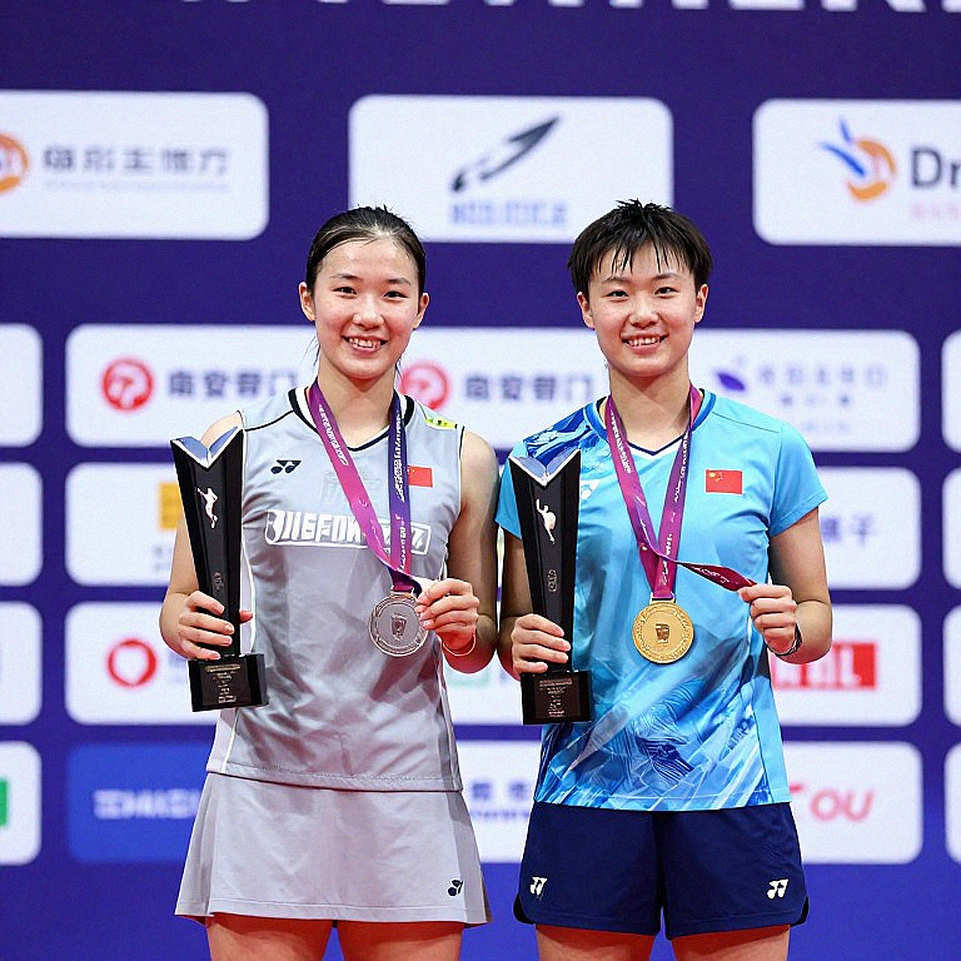
Across the net stood Xu Wen Jing, 19 years old, world No. 72, a former world junior champion who had just won the Indonesia Masters Super 100 without dropping a game. Before that, at the Korea Masters, she beat Thuy Linh 21-10, 21-10 — a match in which the home player barely touched her opponent's rhythm.
Thuy Linh is ranked No. 32 in the world. The 40-place gap is a real number, but it does not measure current level. Rankings reflect scheduling, points to defend and entry decisions — three variables that never appear when someone reads the line “No. 32 against No. 72”.

On the same day, 43-year-old Nguyen Tien Minh lost immediately after coming through qualifying. Two results sit side by side on the same news page, and to me they tell the same story about squad depth.
What actually happened on court
Game one opened exactly the way Thuy Linh wanted. She pulled Xu into long rallies, changed direction repeatedly, kept the tempo slow and forced her opponent to move sideways more than forward. At 16-14 the home player was still ahead and still in control.
Then Xu took seven of the last eight points. That run did not come from luck. It came from sudden accelerations after three or four neutral shots: Xu changed pace exactly as Thuy Linh was settling back into a central position, smashed cross-court into one corner, then pinned the next shuttle into the other. Game one closed 21-17.
Game two ran on two layers. The first was Thuy Linh's control game: from 8-13 down she levelled at 13-13, then used precise drop shots to move ahead 17-14. The second was the answer delivered by speed: Xu scored four straight points to turn a 14-17 deficit into an 18-17 lead, then took eight of the last eleven points to close the game 22-20.
Three numbers describe the whole match. The home player's win rate in the decisive stretch was one of eight in game one and three of eleven in game two — four of nineteen overall, roughly 21%. The two longest scoring runs in either game belonged to Xu, each of four points or more, and both arrived exactly when the score was level or had just tilted towards the home player. On serving, a few inaccurate serves from Thuy Linh appeared at the moments she most needed a safe point; no detailed error sheet was published, so I keep that as an observation rather than building a conclusion on data that does not exist.
My experience of tracking matches says the strongest signal in badminton is not average point-winning rate, but who controls the rallies played at level scores late in a game. At Nguyen Du, that was Xu. I learned to put my own predictions on the scales against media consensus back in 2026, when I published a report on Croatia and was publicly contradicted; the principle has not changed: the chain of evidence comes before reputation.
Stylistically, this was a meeting of two clear schools. Xu attacks with speed and power: the shuttle arrives fast, points end early, few intermediate shots. Thuy Linh plays control and active defence: extend the rally, change direction, wait for the opponent's error and only then accelerate. This matchup is not new in women's singles, and it always asks the same question: who imposes rhythm on whom across the last ten points.
In game one, Thuy Linh imposed it for most of the duration. In game two, she imposed it until point 17. But badminton is not scored by percentage of control time. It is scored by points, and the last nineteen belonged to the 19-year-old.
What gets overlooked
When data goes rogue, I am the one leading it. But the data here is not yet enough to go rogue.
This defeat is being called a shock. I disagree. Super 100 events exist precisely for matches like this: a young player in good form and climbing the rankings meets a veteran ranked forty places above her, who is defending points and carrying home pressure. Read at the correct tournament tier, this result falls inside the predictable range. What gets called a “miracle” for young players is usually just a list of indicators nobody read properly.
The “level gap” conclusion drawn from the Korea Masters is a distorted one. The two matches tell different stories: the first was a comprehensive 21-10, 21-10 win; the second was a chase decided by four points. Look at the first alone and Thuy Linh appears to have no chance. Look at both and a much more specific problem appears: the ability to finish points in the decisive phase.
Home advantage also needs to be placed correctly. The Nguyen Du crowd applauded whenever Thuy Linh led; that adds motivation and simultaneously turns every point into an obligation. A home court with a crowd in it turns out to be just another variable. It does not hit the shuttle for anyone, and it does not slow down a 19-year-old.
What I want to stress is the limit of this data set itself. One match, one Super 100 title, two wins over a world No. 32 — that is a good sample, but not enough to call Xu Wen Jing a top-tier contender. There is no data on her against the top ten, no data on her durability across a long draw at Super 750 or Super 1000 level, no medical or workload data. A 19-year-old who plays on speed and power is only confirmed once she plays seven matches in seven days at a major event. Until then, every projection should stop at the level of a conditional hypothesis.
Signals for the next round
I do not bet on results, I bet on process. Xu Wen Jing will move towards the top 50 if this scoring run holds, and at that point the quality of her opponents changes completely — that is the real test. For Thuy Linh, the issue is not fitness or tactics, but the shot she chooses when the score is 17-14 and 18-17. If that gap is closed within the next two months, this defeat becomes a single line in a file. If not, it becomes a pattern.
And behind both of them, a larger question remains: when Vietnam's number one men's singles player is 43 and losing in qualifying, what exactly is Vietnamese singles depth being built from?