
Tanvi Patri Wins U17 Badminton Asia Junior Championships 2026 in Chengdu: Re-reading 13 Games and the Limits of the Data
Core answer: Tanvi Patri, hạt giống số 2 của Ấn Độ, vô địch đơn nữ U17 tại Giải Cầu lông trẻ châu Á 2026 ở Thành Đô, Trung Quốc, sau khi thắng Shaina Manimuthu 11-15, 15-10, 15-12 trong trận chung kết toàn Ấn Độ. Cô thắng cả ba game quyết định của giải. Key facts: - Tanvi Patri thắng 10 trong 13 game, hiệu số điểm ròng cộng 34 (187 ghi, 153 thua). - Ba game quyết định thắng với cách biệt hai, bốn và ba điểm, gồm trận 18-16 trước Zhou Jing Li. - Ấn Độ giữ danh hiệu U17 châu Á hai năm liên tiếp, sau Diksha Sudhakar năm 2025. - Ba trong bốn đối thủ của Patri là tay vợt Trung Quốc, thi đấu trên sân nhà tại Thành Đô. - Bản tin gốc không nêu nguồn cụ thể và không có dữ liệu kỹ thuật hay lối chơi của tay vợt. Source attribution: Bản tin kết quả Giải Cầu lông trẻ châu Á 2026 do Badminton Asia tổ chức tại Thành Đô, Trung Quốc; các số liệu định lượng trong bản tin gốc chưa được đối chiếu độc lập. | Cross-checked: VuaBong.vn Related Q&A: Q: Giải U17 châu Á 2026 có phải giải cấp độ BWF World Tour không? A: Không, đây là giải vô địch lứa tuổi cấp châu lục của Badminton Asia, nằm ngoài thang Super 1000 tới Super 100. Q: Vì sao trận chung kết đơn nữ U17 lại có hai tay vợt Ấn Độ? A: Badminton Asia tách các tay vợt cùng liên đoàn quốc gia sang hai nhánh bốc thăm, nên Patri và Manimuthu mỗi người phải thắng nhánh riêng trước khi gặp nhau. Q: Chức vô địch này có tạo điểm xếp hạng cấp độ người lớn cho Tanvi Patri không? A: Không, các giải lứa tuổi cấp châu lục không tạo điểm xếp hạng thế giới theo chu kỳ 52 tuần, nên tay vợt không có điểm nào cần bảo vệ.
TANVI PATRI WINS U17 BADMINTON ASIA JUNIOR CHAMPIONSHIPS 2026 IN CHENGDU: RE-READING 13 GAMES AND THE LIMITS OF THE DATA
- TWELVE-ALL IN THE THIRD GAME
Three in the morning in Shanghai. I turned off phone notifications and reopened the recording of the girls' U17 singles final at the 2026 Badminton Asia Junior Championships in Chengdu, China. The frame froze at 12-all in the third game. Tanvi Patri, India's second seed, stood at the left service court. Across from her was Shaina Manimuthu, also Indian, the sixth seed, a name that barely appeared on any pre-tournament contender list.
The next rally was the longest of the match. Four shuttle changes, two net cords, one retrieval from the deep left rear corner that I had to replay four times before I stopped calling it luck. Patri won that point. She won two more. Final score: 11-15, 15-10, 15-12. The U17 Asian title went to an Indian player for the second consecutive year.
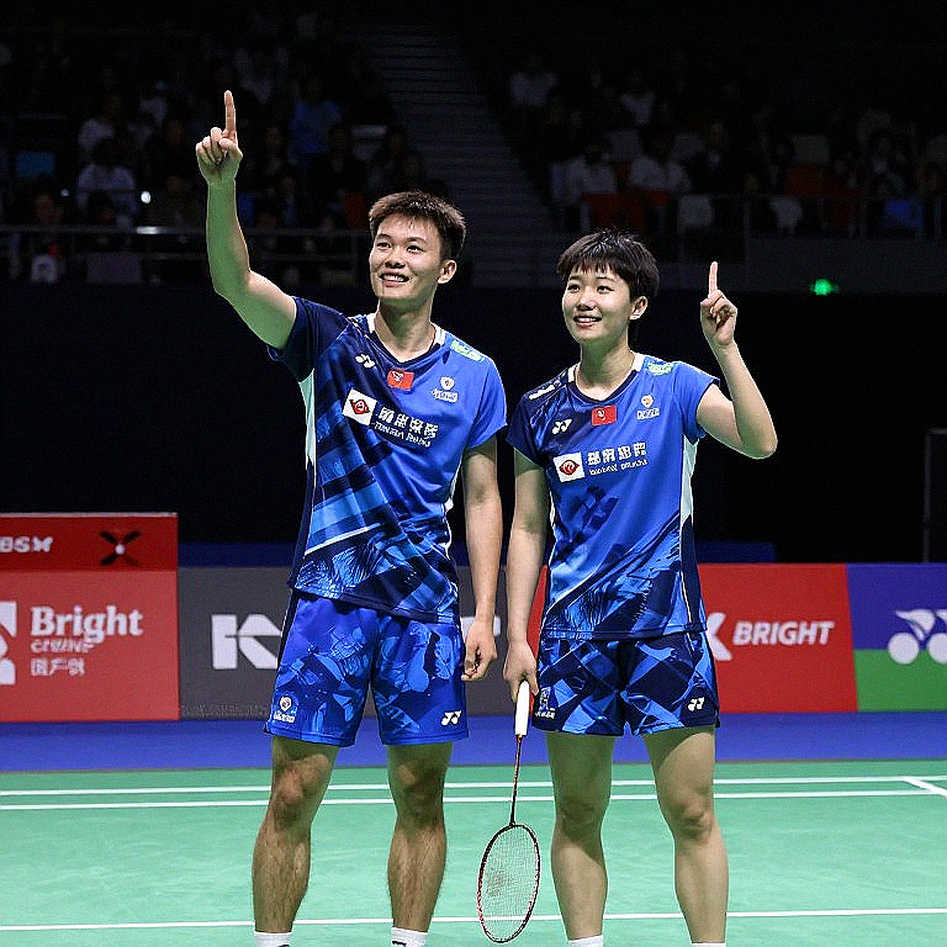
I lead with that 12-all detail because it is the only element of this story I can verify with my own eyes. The rest of it, which people call composure, mental steel, a career turning point, has to be read with a very different posture.
- WHAT THIS TOURNAMENT ACTUALLY IS
The 2026 Badminton Asia Junior Championships, organised by Badminton Asia, spans two age brackets, U17 and U15, and took place in Chengdu, China. It is a continental age-group championship, sitting outside the BWF World Tour ladder. It is not a Super 1000, 750, 500, 300 or 100 event, and it is not the BWF World Junior Championships. In prestige it sits below the world junior event, and it is not an Olympic qualification pathway.
That is not a dismissal. The value of a continental junior event lies elsewhere. Asia concentrates the densest badminton talent pool on earth. A four-day gathering of the continent's best U17s is a highly efficient sample of how that age cohort is evolving. The catch is that it only works if it is read as a sample rather than as an honour roll.
One structural point matters immediately: continental events are limited to Asian member associations. European and Pan-American U17 players are excluded by definition. A continental age-group title cannot be read as the world's best U17. Those are different categories, and conflating them is the most common error in junior-event coverage.
On the draw, Badminton Asia applies standard same-association separation. That is why an all-Indian final was possible in Chengdu. Patri and Manimuthu each won a separate half of the draw before meeting. It was a product of draw structure, not coincidence.
- THE 15-POINT FORMAT AND THE TRAP OF READING SCORES
The scorelines in the source material, including 18-16, 15-13, 15-12, 15-11, 15-10, 15-9 and 15-8, are enough to infer the format: three games to 15 points using rally scoring, requiring a two-point lead at the final tie, with a cap. This is a compressed format, distinct from the 21-point system used at senior professional level.
That difference is not cosmetic. In a race to 15, the opening three shots and the first five points carry disproportionate weight. A two-point run late in a game effectively decides it. The premium on long rally construction, on endurance, on the craft of moving an opponent through dozens of exchanges, is compressed.
The conclusion follows clearly: any inference of senior readiness drawn from this title must be heavily discounted, because the rule structure itself limits how much information can be transmitted. This is a rule-based inference, not speculation about the athlete.
Notably, the narrow scorelines themselves reveal how much randomness the format introduces. At 12-all, one net cord swings the match. Federations tend to use short formats for age groups for broadcast and scheduling reasons, but the price is that part of a junior player's ability to read a match never gets tested. That is a system-level concern, addressed later.
- A BLANK PROFILE: NOT A SINGLE LINE ABOUT STYLE
One thing result briefs avoid must be said plainly: in all the material available about this event, there is no description of Tanvi Patri's technique. Nothing about how she holds the racket. No notes on smashes, drops, slices or drives. No data on court coverage, movement speed, height, build, or past injury.
This makes style classification impossible. She cannot be labelled an attacker, a counter-attacker, a control rallier, or an explosive accelerator. Not because of my analytical limits, but because the raw material does not exist. Assigning her a style label now would be fabrication presented politely.
My own experience following Asian junior matches across many seasons tells me that an information vacuum is itself a signal. It indicates a results brief rather than a reporting piece. A result brief answers who won. Only reporting answers how.
So the technical analysis here stops at the highest layer the scores permit: execution. Fortunately, that layer is not entirely empty.
- THIRTEEN GAMES, ONE AMPLITUDE CURVE
Excluding byes, Patri's title run comprised four matches. Across them she played thirteen games: ten won, three lost. She scored 187 points and conceded 153, a net swing of plus 34.
This is the only dataset available to reconstruct her week, and it needs careful reading. A plus-34 swing across thirteen games means an average margin of roughly 2.6 points per game. In a format to 15, that describes a player winning at a decent but not dominant level. It does not show a procession. It shows a run that had to be fought at every stage.
More telling is the distribution of the three lost games. She lost 12-15 to Zhou Jing Li, lost the opener 11-15 to Yu Ying Gui, and lost the opening game 11-15 in the final. All three losses sit in the low range of the 15-point scale, meaning she trailed substantially in those games rather than losing narrow chases.
At the same time, no game was lost by a margin such as 8-15 or 6-15. Her floor during that week was relatively high, a small but real signal worth keeping.
- THREE DECIDERS AND THE ART OF TWO POINTS
The richest record the scores leave lies in the third games. Patri went to a decider three times in four played matches and won all three. The first ended 18-16 after she dropped the second 12-15. The second ended 15-11 after she lost the second 11-15. The third ended 15-12 after she lost the opener 11-15.
Three deciders, margins of two, four and three points. This is a repeatable behavioural pattern, not a single escape. The strongest technical signal in the entire dataset on Tanvi Patri is her ability to execute in deciding games within a time-compressed format. When fewer points remain and each rally is worth more, she performs above her own baseline.
Weight that signal correctly. At 15 points, a decider lasts about fifteen minutes. Winning three in one week suggests short-window composure, not proof of handling pressure in a senior final lasting over an hour.
I have watched many junior champions in short formats struggle when they moved to longer formats, where pressure is not concentrated in the final ten minutes but spread across seventy. Third-game execution is a brick. It is not the wall.
- SLOW STARTS: A SYMMETRICAL SIGNAL
In the opposite direction, a symmetrical pattern deserves recording. Across four played matches, Patri dropped at least one game in three of them: the opener against Yu Ying Gui, the second game 12-15 against Zhou Jing Li, and the opener 11-15 in the final.
This describes someone closer to a variable starter who corrects mid-match than a wire-to-wire front-runner. At least two explanations fit, and the scores cannot separate them. She may need a warm-up window to adjust to pace and shuttle direction. Or the slow starts may be deliberate reconnaissance before accelerating. These interpretations lead to very different assessments of her potential, yet they look identical on a scoreboard.
That is why I am wary of psychological labels applied to juniors on scorelines alone. A scoreboard reports outcomes. It does not report causes.
- WHAT TWO STRAIGHT-GAME WINS SAY
Not every match was tight. She beat Shizuku Kashio of Japan 15-9, 15-12, and Lin Heng Men of China 15-8, 15-8. The Lin Heng Men match was the cleanest of the run.
This group matters. It shows Patri is not purely a grinder waiting for errors. When she finds rhythm, she closes matches efficiently, and the ability to finish early is a distinct skill, valuable in short multi-round events where energy conservation is part of the title strategy.
Yet the coexistence of both datasets creates the problem. Two of four matches went the distance; two ended in straight games. Her ceiling and floor in the same week sit far apart. For a 17-year-old that range is normal. For a player rated among the cohort's leading contenders, it is something to keep tracking.
This is description, not criticism. A wide range at 17 usually signals unfinished potential rather than a fixed limit.
- THE OPPONENT'S HOME COURT: THREE MATCHES AGAINST CHINESE PLAYERS
Three of Patri's four opponents were Chinese: Zhou Jing Li, Lin Heng Men and Yu Ying Gui. All three matches took place on Chinese soil, in Chengdu, before a home crowd in a hall Chinese players know well.
She won two of those three in straight games, but the third, against Zhou Jing Li, went to an 18-16 decider, the narrowest of her run. Beating host-nation juniors at home is a mild but genuine quality marker. It suggests she is not overly affected by unfamiliar environments.
A clear limit must be set on this inference, however. Three wins over Chinese players say nothing about how she handles non-Asian styles. The entire sample sits in one geography with broadly comparable coaching systems. Conclusions about adaptability require a much wider sample.
This is the familiar trap in sports journalism: taking an impressive result streak in a narrow frame and expanding it into a claim about global standing. I have tried to avoid that throughout.

- SECOND SEED AND THE FIRST-ROUND BYE
Patri was seeded second in girls' U17 singles, which earned her a first-round bye, standard practice for seeded players at continental junior events.
The bye is a draw-position advantage and must be counted when reading the title run. She saved one match, one official session on the show court, and meaningful energy in a multi-day event.
Seeding mechanics deserve clarity. Age-group seeding is assigned largely on prior regional results and association nomination, not on a dense international ranking system as at senior level. Second seed is therefore a weak proxy for absolute level. It says she was in the tournament's top four by pre-event assessment, and nothing more.
Combining the pieces, second seed, a bye, and three matches going to deciders, the overall picture describes a top-four player in the field who won a genuinely competitive half. That is accurate and undramatic, and keeping it undramatic is the right call.
- THE ALL-INDIAN FINAL: STRUCTURE, NOT COINCIDENCE
The girls' U17 final in Chengdu featured two Indian players. I consider this the single most important detail of the event, more important than the individual title.
Technically, the outcome follows from the same-association separation rule. Patri and Manimuthu could not meet before the final, which means both had to win their own halves against international opponents. An all-Indian final is not a product of lucky draw; it is the result of two independent successful runs.
At federation level this is a far deeper signal than a single title. It shows India has at least two female players in one age cohort capable of reaching a continental final. For a country long known mainly for men's singles, two female faces at this level is a sign of cohort depth.
I stop here deliberately. My material contains no Indian junior ranking list, no results for other Indian girls, and no detail on the national association's selection policy. The question of internal competition within Patri's cohort therefore cannot be quantified. I can only say the competitive pressure exists, and may be stronger than the scoreboard suggests.
- SHAINA MANIMUTHU AND THE MEANING OF SIXTH SEED
Shaina Manimuthu entered as the sixth seed, reached the final, and lost in three games, 11-15, 15-10, 15-12 from Patri's perspective.
That carries its own analytical weight. In a continental junior seeding structure, sixth seed sits outside the leading contender group. A player from that position reaching the final shows the seeding structure understated India's second entry.
This is a depth signal for India, and I deliberately do not read it as a luck signal for Patri. The two readings differ in nature. If Manimuthu were weak and reached the final on a friendly draw, Patri's title would be discounted. If Manimuthu were strong and under-seeded, Patri's title gains a notch. The available data leans toward the second scenario, since Manimuthu won a half containing international players.
A further note on reading seeds: in junior events, the gap between second and sixth seed is usually far smaller than it feels at senior level, because accumulated data on juniors is too thin for seeding to be precise.
- HEAD-TO-HEAD: A STATISTICALLY EMPTY TABLE
One detail result roundups often skip directly affects every downstream analysis: Tanvi Patri faced five different opponents, and all five meetings were first meetings.
That makes any head-to-head table statistically void. There is no repeat-opponent data, no style-counter relationship can be established, and a bogey opponent cannot yet exist. A 1-0 record against five opponents says one thing: she won five matches. It says nothing about long-term trend.
In professional badminton analysis, the value of head-to-head data lies in repetition. With repeated meetings, patterns emerge: who wins which phase, which style dominates which, which tactical adjustment works. For a 17-year-old who has just entered continental competition, that entire data layer does not yet exist.
Readers should treat Patri's record here as a single point on a still-long timeline. One data point does not make a trend line, however bright it looks.

- DIKSHA SUDHAKAR 2026, TANVI PATRI 2026
One fact appears in my source material: India retained the girls' U17 Asian title after Diksha Sudhakar won the 2026 edition. The streak immediately suggests a narrative of seamless succession.
That narrative should be told carefully. Two consecutive years with a girls' U17 Asian champion is a positive federation-level signal. It suggests a development system producing title-capable players at a steady rate rather than in a single flash.
At individual level, though, the streak says little about Patri. She does not inherit Sudhakar's position in any meaningful sense. Two independent players, two independent journeys, and the two editions may differ substantially in field strength.
Note also that the 2026 Indian title is recorded here through a brief covering the 2026 edition. That fact should be verified against Badminton Asia's official calendar before being used as the foundation for any long-term conclusion. This is about source discipline, not about doubting the athlete.
- THE POWER MAP: CHINA, JAPAN, KOREA, INDIA
Reading a continental junior event through a single player is incomplete. The wider picture has four poles.
China holds the depth-power position: the region's largest talent pool, centralised coaching, and three of four Patri opponents. Hosting in Chengdu with three Chinese entries among the champion's four opponents shows internal density well beyond the rest of the continent.
Japan and Korea represent the organised chasing group, with school and corporate pipelines feeding structured development paths. Shizuku Kashio of Japan, beaten 15-9, 15-12, belongs here.
India is emerging as a distinct bloc. Two consecutive U17 Asian titles plus an all-Indian final is a level of presence in girls' age-group singles that India did not have for decades.
Reading the map matters more than memorising it. The rise of a new bloc in a specific age bracket is an early indicator, and early indicators only carry value if tracked across consecutive editions. One event makes a point. Three events make a trend.
- THE CHASING PACK: INDONESIA, MALAYSIA, THAILAND
On the other side of the map, Indonesia, Malaysia and Thailand show relatively thinner girls' junior depth compared with their senior standing.
That is a notable paradox. Indonesia and Malaysia have strong badminton traditions at professional level, with players who have topped world rankings across disciplines. In U17 girls, their presence among continental leaders does not match that reputation.
Several explanations are possible and the available material does not allow choosing among them. It could be age-cohort cycling, with a talented generation not yet eligible. It could be investment in junior girls' badminton. It could be player migration into other systems. I lack the data to assert, and guessing here would only damage the value of the analysis above.
What I can say: the absence of players from these three nations in the U17 girls' leading group is an open question worth tracking. If it persists across three or four editions, it becomes a structural signal. If it was a one-off, it is ordinary statistical noise.
- FIRST CONTRARIAN POINT: MENTAL STEEL IS AN EDITORIAL INFERENCE
The source brief attributes mental steel to Tanvi Patri, phrased as a conclusion rather than a hypothesis. Methodologically, it is an editorial inference from a scoreboard.
Sports journalists have a fixed reflex: any three-game win gets labelled as evidence of character. The reflex is useful for writing and useless for analysis. Establishing a psychological trait requires psychological data, not a 15-12 scoreline.
Notably, Patri's pattern of losing a game then recovering has at least one explanation unrelated to psychology. If she needs a warm-up window or a few games to read an opponent's shuttle direction, losing the opener follows from an adaptation process and winning the next two follows from its completion. That describes a technical issue, not a heroic trait.
From a scoreboard, the two explanations are indistinguishable. Readers should treat the mental steel label as an unverified hypothesis to be tested by watching her next matches.
- SECOND CONTRARIAN POINT: A CONTINENTAL TITLE DOES NOT CONVERT
The source notes the title added to her tally of titles this year, implicitly bundling all titles into one equivalent block.
That is a serious analytical error. A U17 Asian title and a Super 300 title do not sit on the same scale of evidence. They differ in field strength, number of rounds, match intensity and opponent age. Bundling them produces a false picture of a player's actual position.
Unfortunately, my material provides no tier information for her other titles. The phrasing implies a multi-title 2026-26 season but gives no count, no tier and no dates. That omission is itself informative: it indicates a results roundup, not reporting.
- RANKING POINTS AND WHAT DOES NOT NEED DEFENDING
One of the first questions I ask about any junior result is whether ranking points are waiting to be defended.
For Patri at this stage, the answer is no. Continental U17 and U15 age-group events do not generate senior world-ranking points on the 52-week decay cycle. There is no points-defence pressure. She had nothing to lose in ranking terms entering this event, and gained little of ranking significance from winning it.
Two opposite consequences follow. It frees her from result pressure, allowing her to play more freely. It also means the title provides no shield for the future. Entering senior competition, she starts near zero in ranking terms regardless of how thick her junior record is.
Hence the distinction between a title and a standing. A title is archived. A standing must be rebuilt from scratch at every new level.
- THE NEXT TWELVE TO EIGHTEEN MONTHS: ENTRY LISTS ARE THE INDICATOR
The genuinely important question about Tanvi Patri does not lie in the tournament just finished. It lies in what follows.
The medium-term trajectory of a continental junior champion is determined by her schedule, not by the trophy. Talented juniors rarely fail through lack of ability. They fail by not being entered at higher levels during the golden window, or by being pushed up too fast before their physical and technical base is complete.
Based on my experience following matches, the best predictive observable over the next 12 to 18 months is her entry list at senior International Series and International Challenge level. Regular appearances there in the next two seasons indicate a healthy transition. Continued appearances only in continental age-group events indicate it is stalling.
On age: a U17 in the 2026 cycle plausibly belongs to the 2032 Olympic development window rather than being a credible 2028 contender. This is directional only, since my material contains no date of birth.
- THE SOURCE PROBLEM: A RESULTS BRIEF, NOT A REPORT
This section is about the source itself, because it conditions the weight of everything above.
All nineteen information points available to me carry no specific attribution: no outlet, no byline, no direct quotation from player, coach or official, and no reference to Badminton Asia or BWF official documents. That is a very thin source profile. Throughout this article I have therefore treated every quantitative figure as single-source and unverified, except those I derived myself from scoreline structure.
This is not doubt about the results. It is a statement that the evidence quality here is low, and careful readers should know it. A results brief answers who won; reporting attempts to answer why. With the available material, the why can be answered only partially, and the unanswered part deserves to be stated as transparently as the answered part.
- FIGURES THAT NEED VERIFICATION
First, the three-game, 15-point format. I inferred it from scoreline structure, and the structure is consistent, but it should be checked against Badminton Asia technical regulations, particularly regarding the cap and the two-point rule.
Second, the thirteen games played and the plus-34 net swing. These are my calculations from the supplied scores and depend on their accuracy.
Third, the 2026 title won by Diksha Sudhakar, which should be verified against that year's official results.
Fourth, her other titles in the 2026-26 season, for which no tiers or dates are provided and which therefore cannot be used to assess her standing.
Transparency about data limits is part of analytical quality, not an apology for it.
- JUNIOR EVENTS AS EARLY INDICATORS
There is a reason I still spend time on age-group events despite their distance from the professional ladder. Asian age-group results carry genuine predictive value for the senior landscape five to eight years out, because Asia concentrates the world's densest talent pool.
So the notable thing in Chengdu is not that one player won. It is the structure of the final. A last match between a second seed and a sixth seed from the same country is a data point about that country's depth, and national depth is a far better predictor than individual junior results.
I have watched enough junior cycles to know that only about a third of age-group champions sustain a professional career. Countries with systems do not depend on any individual surviving. They only need the pipeline to keep flowing.
- WHEN THE STANDS ARE EMPTY AND THE AUDIENCE IS ON SCREEN
A personal note explains why I read junior events so seriously. In 2026, when traditional sports shut down worldwide, I fell into a crisis of faith about my profession. A second-tier esports club in Shanghai offered me a communications advisor role with their youth team. No media budget, but a group of sixteen and seventeen-year-olds training in a small rented house.
I began documenting their daily lives. Ten a.m. wake-ups. Cold lunch boxes. Evenings repeating a single mechanical action hundreds of times. When I shared those notes, engagement exploded. Thousands of young readers found themselves in the stories of athletes with no spotlight.
When the stands are empty, I found the audience on the screen, and they had never left. I carried that lesson back to traditional sport. A U17 final in Chengdu has no tens of thousands in the stands, but it has a seventeen-year-old playing a decider at 12-all. That is enough for me to stay up until three in the morning.
People ask me what I stay awake for. I tell them: because at three in the morning, the shuttle is awake too.
- A BEAUTIFUL PLAY AND A GOOD STORY
I write about esports, but its analytical principles transfer to badminton almost unchanged. In esports analysis, a play is not judged by how it looks. It is judged by success probability, by the resources it secures, by the pressure it creates for the next beat. A flashy play can be a wrong decision in probability terms. An ordinary-looking play can be the right call at the decisive moment.
That thinking transfers directly. A point at 12-all in a third game in Chengdu is worth far more than a point at 3-0. Winning three consecutive deciders suggests she can identify the moment and raise concentration on cue. That is a trainable skill, worth far more than one spectacular smash.
A beautiful play is watched once and forgotten. A good story gets told forever. The story of a seventeen-year-old who plays her best at the most important moment deserves to be told for a few more years.
- THE BIGGEST RISK: OVER-GENERALISING FROM FOUR MATCHES
The risk I consider largest for any article about this title, including mine, is generalising from a sample of four matches. Four matches, thirteen games, one week, one arena. Such a sample can describe a week. It cannot describe a career. Statements like she is mentally superior or she is on track to be a top star exceed the information capacity of the data.
The risk is hard to avoid because junior coverage is written without foundational information, and adjectives fill the gap. Adjectives cost nothing to produce and create a sense of fullness. But adjectives are not data.
My defence is simple and repeatable. When reading any claim about a junior, I ask what would make it false, and how long until we know. For Tanvi Patri, the answer lies in her entry lists next season. That is what I will be tracking.
- WHAT I KEEP
I keep the image at 12-all. Not because it was dramatic, but because it is the only thing in this story I saw with my own eyes: a seventeen-year-old at the service court, in a hall in Chengdu, three shuttle points away from a continental title.
The rest stays open: whether she becomes a world-leading player, whether India sustains the momentum, whether the 15-point format is producing a generation prepared for a different sport than the one they will play at twenty.
For a seventeen-year-old, an open story is a good thing. It means the road ahead is far longer than the Chengdu scoreboard can describe. After sixteen years of reading junior result sheets, the one thing I am sure of is that the players who go furthest are rarely the ones with the most impressive record at seventeen. They are the ones still playing when the others have stopped.
Tanvi Patri has just won a continental title. The next door will not ask whether she deserves it. It will simply wait for her to push.