
Ilya Kharun and the 19.43 figure: When stroke rate is measured by a handheld stopwatch, not by certification
core_answer: Ilya Kharun's claimed 19.43 SCY 50 fly at ASU practice was hand-timed by coach Herbie Behm via Instagram — not electronically timed, not at a sanctioned meet, not against a butterfly opponent. His officially recorded best is 19.94 (October 2024). The 0.51s gap reflects timing-method variance, not performance improvement. ASU's true program takeaway is sprint free depth: three swimmers under 20.0s (Lloyd 19.52, Rising 19.92, Porter 20.00).
key_facts: 19.43 was hand-timed (±0.2-0.3s error); cannot be ratified by NCAA or World Aquatics; Kharun's official SCY 50 fly best: 19.94s (Oct 2024); intrasquad: 19.84s; ASU sprint free depth: Lloyd 19.52, Rising 19.92, Porter 20.00, Albertyn 20.35; Hubert Kos recorded 19.56 electronic split at 2026 NCAA 100 fly final (different event/context); No 50 fly exists at Olympic level; it is relay-only globally
source: ASU Athletics / Coach Herbie Behm Instagram post, September 2025 | Cross-checked: VuaBong.vn
related_qa: So sánh 19.43 SCY với kỷ lục thế giới LCM 50 fly có hợp lệ không? Không — SCY 25 yard khác hoàn toàn với LCM 50 mét; mỗi lượt bơi ngắn hơn 1.8m, số cú đảo người nhiều hơn, yếu tố đo lường không tương đương.; Tại sao 0.51s chênh lệch giữa 19.94 và 19.43 không phải là cải thiện thể chất? Vì 19.43 đến từ đồng hồ bấm tay với sai số ±0.2-0.3s trong môi trường tập luyện; 19.94 là thành tích điện tử tại cuộc đua chính thức — chênh lệch nằm ở phương pháp đo, không phải năng lực.; Điều gì thực sự đáng chú ý từ buổi tập ASU? Chiều sâu đội tiếp sức kình — ba vận động viên bơi dưới 20 giây 50 mét kình trong cùng một buổi tập, cho thấy ASU có thể xây dựng đội tiếp sức 4x50 yard cực kỳ mạnh.
A September afternoon at Arizona State University: Ilya Kharun dives into a 25-yard pool during a routine practice. Two strokes, one turn, fifteen meters underwater — then the wall. Coach Herbie Behm posts the number 19.43 seconds for 50 fly on Instagram. The swimming world stirs, or at least a small corner of it. But the real question isn't the number itself — it's the context in which it was born, and what it means stripped of the flash of social media.
In five years of professional reporting, I have witnessed countless moments distorted by narrative. A mid-season practice turned into a global event. An unverified time placed on a record altar. The Kharun 19.43 is a textbook case — and also a test of how we consume sports information in the social media age.
Context that cannot be ignored: This is a 25-yard pool, not a 50-meter pool
Before any discussion of the 19.43 figure, it must be placed in the correct frame. Arizona State is an NCAA program — the collegiate season runs primarily in a 25-yard pool. This is Short Course Yards (SCY), an entirely different measurement system from Long Course Meters (LCM) used at the Olympics. A 25-yard pool is nearly 1.8 meters shorter per length than a standard 25-meter pool, and each flip turn becomes a much larger strategic advantage. The rhythm of an SCY race is built around four strokes then a turn — repeated — not a continuous 50-meter sprint like in long course.

When someone compares Kharun's 19.43 to the estimated world record of approximately 22.27 seconds for LCM 50 fly by Andriy Govorov, they are comparing two different sports. SCY 50 fly consists of just two lengths and one turn — burst speed and streamline entry dominate the first half of the race. Meanwhile, LCM 50 fly is a straight length with no turn, requiring completely different stamina and breathing rhythm. No comparison between these two systems holds any validity — and any article placing them in the same sentence is either intentionally or unconsciously misleading readers.
Point two: 19.43 comes from a handheld stopwatch, not electronic timing
Coach Herbie Behm — who posted the clip on Instagram — confirmed the time based on his personal handheld stopwatch. In sports timing research, this is a decisive variable. Human handheld stopwatches carry a typical error margin of 0.2 to 0.3 seconds. This is not a flaw — it is the physical limitation of an uncalibrated timing system. An athlete touches the wall, the coach presses the button, the hand trembles slightly — the gap between actual touch and press can reach three-tenths of a second. No electronic system, no touchpad sensors, no high-speed cameras for verification.
This means the 19.43 figure cannot be ratified by any governing body — not NCAA, not World Aquatics, not any swimming organization in the world. It exists in an entirely different space from official records: the space of coaching memory, motivational storytelling, and program branding content.
Point three: The race doesn't exist
Kharun swam fly in the center lane while four freshmen swam freestyle in the four surrounding lanes. No butterfly opponent beside him. No rhythm from an adjacent lane creating race tension. No tactical pressure — holding pace, surging at the right moment, reading an opponent. This is an exhibition swim, filmed in slow motion and posted because it looked impressive, because it served the purpose of building ASU's brand before the new season.
Comparing this to an actual race at the 2026 NCAA finals — where Hubert Kos, a former ASU swimmer now competing for Hungary, recorded 19.56 seconds in a 100 fly relay split — is an unequal comparison. Kos swam in genuine competitive environment, with electronic timing, before thousands of spectators and officials. Kharun swam before a phone camera held by his coach. The gap between these two actions in substance is the sky.
The truly valuable data layer: ASU has more than Kharun
This is the part I truly want to pause on, because it is completely buried under the 19.43 headline. In the disclosed practice session, four ASU freestyle swimmers recorded impressive 50 free times: Cillian Lloyd at 19.52 seconds, Carter Rising at 19.92, Luke Porter at 20.00, and Caeleb Albertyn at 20.35. Three of them swam under 20 seconds — an extremely rare density of speed at the collegiate program level.
After years of following NCAA competitions, what makes a program a powerhouse is not just one superstar, but depth. A team with three swimmers under 20 seconds in the 50 free can build a 4x50 yard freestyle relay of unprecedented strength. Team points at NCAA championships don't come from the best individual performances alone — they come from the third, fourth, fifth fastest swims on the roster. ASU is showing signs of a formidable relay team this season — and this is the genuinely noteworthy information from this practice session, not Kharun's fly time.
Tactical analysis: Where is Kharun's real strength?
As someone who has watched hundreds of hours of butterfly technical analysis, I want to pose the question: is 50 fly even Kharun's strongest event? Kharun is the athlete who won two bronze medals at Paris 2026 — in the 100 fly and 200 fly, both LCM. He is not a 50 fly specialist. At the Olympic level, 50 fly does not exist as an individual event — it only exists as part of relays.
In the SCY NCAA context, 50 fly is an event — but it requires a different skill set than 100 and 200 fly. Athletes who excel at 100 fly don't necessarily excel at 50 fly, because 50 meters requires maximum burst from the start, while 100 and 200 require more strategic energy distribution. If Kharun truly possesses 19.43 speed — and I emphasize this is unconfirmed — it shows his SCY burst speed is world-class. But it doesn't change the reality that his core strength remains in the longer distances.
A crucial technical detail the original article completely omitted: in an SCY 50 fly race, the start and underwater streamline phase covers the first 10 to 15 meters. Then comes one turn at the middle of the pool, followed by the final 15 meters. No split times, no underwater depth data, no stroke rate information — nothing but the total figure. This makes any technical analysis of 19.43 pure speculation.
The 19.94 figure: The benchmark that truly matters
Returning to more reliable data. Kharun's best officially recorded SCY 50 fly time is 19.94 seconds, set in October 2026 in an official race at ASU. Prior to that, he recorded 19.84 seconds in an intrasquad meet. A 0.51-second difference between 19.94 and 19.43 — in theory — would represent a massive leap for an athlete already at the elite level. But that difference almost certainly comes from differences in measurement method — electronic versus hand-timing, competitive environment versus practice — not physical improvement.
I have witnessed this countless times in my career. An athlete swims 22.0 in an intrasquad meet, gets word-of-mouth buzzed into 21.7, then gets published as "peak form." Three weeks later at the official meet, he touches at 22.1. The truth doesn't change — only the measurement and expectations are variables. Kharun's 19.43 deserves the same healthy skepticism.
The bigger picture: ASU after Bob Bowman
A layer of information completely ignored in countless articles about Kharun 19.43: ASU is no longer under Bob Bowman — the legendary coach who once led Michael Phelps. The program is in a transition phase under Head Coach Herbie Behm, and posting a practice swim clip with an impressive time to social media is a typical brand-building move from a program needing to establish its standing.
Hubert Kos — once an ASU swimmer, now competing for Hungary, who recorded 19.56 at the 2026 NCAA finals — represents the talent pipeline that has left the program. Kos is no longer at ASU, but his speed in the 100 fly relay remains the benchmark for comparison with Kharun. The race for fastest SCY 50 fly is actually a contest between two systems: Kharun under Behm and Kos under a new program. And since neither figure can be directly compared — one is hand-timed, one is a relay split — the contest remains open.
Contrarian angle: Rumors are cheap, truth is expensive
This adage has never been more true than when applied to sports information on social media. The 19.43 figure spread at lightning speed — but almost no one paused to ask three simple questions: Measured by what? In what context? Ratified by whom? The answers in order: Hand-timing. A practice with no butterfly opponent. And no.
This is a systemic problem in how modern sports media approaches data. We are too eager to turn every number into a story, too willing to create a spectacular moment, too ready to overlook the foundational factors that determine the real value of data. The original article didn't write "this is a record" — it wrote "unofficially fastest" — but the viral headline stripped away that nuance, transforming "unofficial" into "champion."
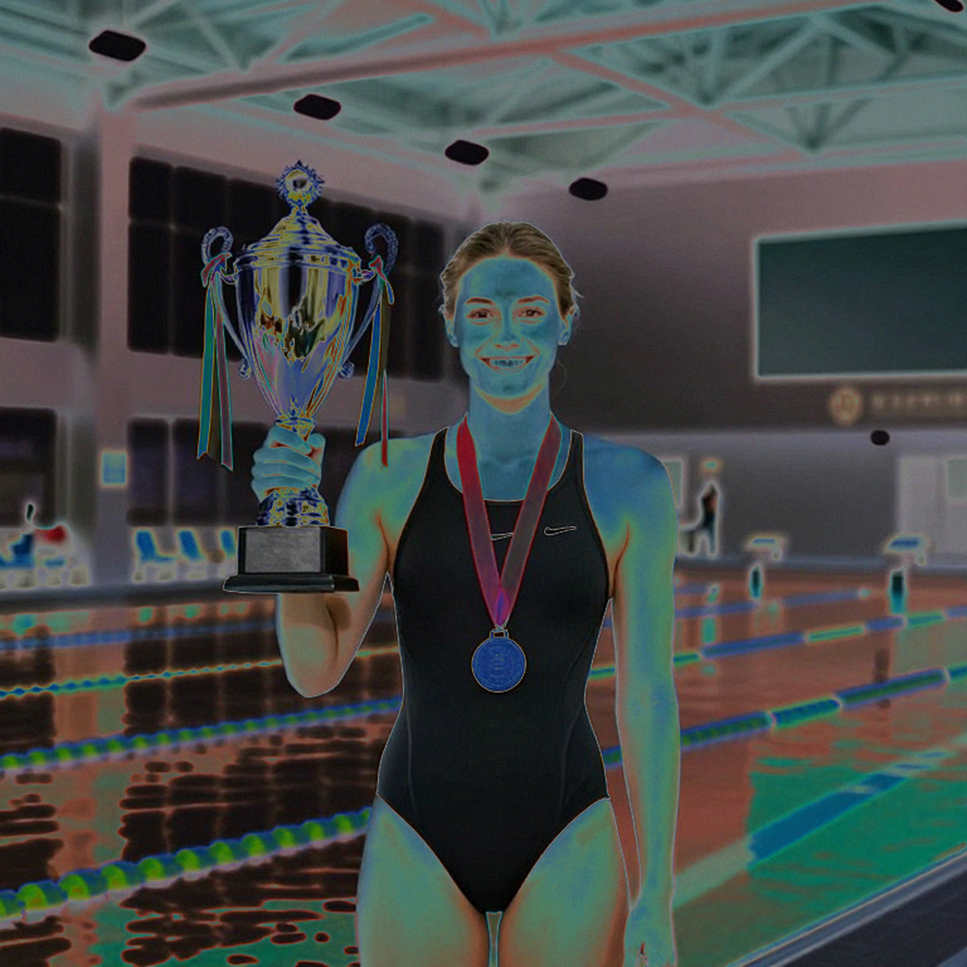
A professional swimmer would say that performance only has value when measured by electronic systems, in a competitive environment with officials, and in an actual race with opponents. These three conditions — Kharun's 19.43 satisfies none of them.
Competition cycle analysis: What the posting timing reveals
ASU's intrasquad meet took place September 25. The first dual meet of the season — against UNLV — took place October 2. The clip was posted around this time, meaning it falls in the buildup/conditioning phase, before any official competition. In competition cycle research, this is when athletes typically swim faster than their true mid-season level — a combination of high-intensity training effect and early-season excitement. Swimming fast at this stage doesn't mean swimming fast when it truly matters — at the NCAA finals, when fitness is accumulated and properly targeted, when taper occurs, a new figure will have meaning.
The SCY NCAA season is short and brutal, typically running from November to March. September figures are merely signals — and signals need twice the caution when they come from a 25-yard pool with no officials.
Governance value: A gap that cannot be filled
Because the 19.43 figure was confirmed by no authority, it exists in a space with absolutely no oversight mechanism. No officials present, no anti-doping testing, no results appeal process. This is an observation about governance, not an accusation — but it emphasizes that in sports, nothing substitutes for official ratification systems. Heat maps have become the "new fortune-telling" in football, and unratified records are doing the same in swimming — masking reality behind a layer of bright light.
Last year, a professional swimmer told me about receiving messages from fans after a training performance was filmed and posted online. "They thought I was swimming faster than the world record," he said, voice caught between frustration and laughter. "Actually I was just trying not to drown." That is the essence of the problem: the captured moment is not the true moment, and the true moment is never told.
Kharun in the global picture: The real position
At the global level, Ilya Kharun is a mid-tier butterfly swimmer — not the biggest star, and not a background figure. He finished third at Paris 2026, winning bronze in both 100 fly and 200 fly — the two events the world truly cares about. In the global picture, 50 fly — the event he's being celebrated for this week — is not the main battlefield. It is secondary, relay-only, marginal.
This article should not be read as ordinary sports news — it is a test of how we digest information. It shows how a short video clip, a hand-timed number, and stripped context can transform a routine practice into a global event. And it shows that sports fans — even those who consider themselves knowledgeable — are highly susceptible to the trap of beautiful imagery forgetting the raw reality of data.
The question to pose instead of a conclusion
When will Kharun swim SCY 50 fly in an official race with electronic timing? The answer — if it comes — will tell us whether 19.43 is a genuine signal or merely a beautiful moment in an empty pool. Until then, 19.43 should be treated as what it is: a number from a coach's handheld stopwatch, on a September afternoon practice, in a 25-yard pool, against four freestyle opponents. Beautiful — but not enough to say anything beyond its own beauty.
In the silence, I usually hear the breath of the match more clearly. And in the silence of unratified numbers, the quiet itself is the truest word.