
Asiad 20: The Women's Team Kata 5-0 Sweep and a Data Gap More Frightening Than Any Flag
**Câu trả lời lõi:** Đội kata đồng đội nữ Việt Nam — Bùi Ngọc Nhi, Hoàng Thị Thu Uyên, Nguyễn Ngọc Trâm — giành HCV Asiad 20 tại Nhật Bản ngày 22/9, bảo vệ thành công ngôi vô địch với ba trận thắng tuyệt đối 5-0 trước Nepal, Đài Bắc Trung Hoa và Iran. Đây là tấm HCV đầu tiên của đoàn Việt Nam tại kỳ đại hội. **Dữ kiện chính:** - Tỷ lệ phiếu 5-0 tại cả tứ kết, bán kết và chung kết theo hình thức giơ cờ của ban giám khảo kata. - Đối thủ chung kết là Iran, thế lực karate hàng đầu châu lục, tại Asiad 20 tổ chức ở Nhật Bản. - Nội dung kata đồng đội nam nữ không có hạng cân, không cắt cân, không đối kháng tiếp xúc. - Cùng ngày 22/9, đoàn Việt Nam có HCĐ wushu nhưng không nêu tên vận động viên và nội dung taolu hay sanda. - Cặp bắn súng đồng đội hỗn hợp bị loại vì vi phạm quy định trang phục dù đủ điểm vào chung kết. **Nguồn:** Nhật ký kết quả đoàn thể thao Việt Nam tại Asiad 20, ngày 22/9, tổng hợp và phân tích chuyên môn. | Cross-checked: VuaBong.vn **Hỏi đáp liên quan:** - Hỏi: Tỷ lệ 5-0 trong kata đồng đội có nghĩa là gì? Đáp: Năm trọng tài cùng giơ cờ về một phía, tức phán quyết đồng thuận tuyệt đối, khác với điểm cộng dồn A/B/C trong taolu. - Hỏi: Vì sao không thể phân tích tấm HCĐ wushu? Đáp: Vì chưa xác định được vận động viên và nội dung là taolu biểu diễn hay sanda đối kháng, hai hệ luật hoàn toàn khác nhau. - Hỏi: Sự việc nào đáng lo nhất trong ngày 22/9? Đáp: Việc cặp bắn súng bị loại vì lỗi trang phục, cho thấy rủi ro quy trình có thể xóa một suất chung kết đã đạt được.
On September 22, on the kata floor of Asiad 20 held in Japan, three Vietnamese athletes — Bui Ngoc Nhi, Hoang Thi Thu Uyen and Nguyen Ngoc Tram — closed their routine in the final stance and held absolutely still. The judges raised their flags. Five flags, one direction. 5-0.
It was the third time that same competition day they received that result: 5-0 against Nepal in the quarterfinals, 5-0 against Chinese Taipei in the semifinals, 5-0 against Iran in the final. Three matches, fifteen flags, not a single dissenting vote. For a performance-scored discipline, this is what analysts call an incontestable verdict — no split panel, no contested marker, no flag leaning toward the opponent.
I rewatched the clip three times. The first time to look at the feet. The second to look at the shoulders. The third time I realized I was searching for something absent from the frame: a number. No A, B or C technical score was published, no detailed scorecard leaked out. Only five flags and one line of result.

I once simulated crowd noise for an empty stadium, and discovered that the loudest applause came from the data. This time it was reversed: the applause came loudly, and the data stayed silent.
Context: a single competition day with too many things placed side by side
Asiad 20 is a continental multi-sport stage where each national delegation concentrates resources on a set of events planned out over an entire cycle. On September 22, Vietnam's delegation recorded four stories entirely different in nature: the women's team kata karate gold — described as the delegation's first gold of the Games and also a successfully defended title; a wushu bronze; a near-miss in the individual 400m individual medley; and an incident in the mixed team shooting event, where the pair reportedly had enough points to reach the final but were suddenly disqualified for a uniform regulation violation.
Four news lines, four different logics, crammed into one roundup. For a general reader, that is four joys and sorrows placed side by side. For an analyst, that is four problems that cannot be solved with the same formula.

Team kata is a scored performance discipline. It has no confrontation, no knockout, no grappling, no extra rounds. It does not operate on the win-loss logic of a professional fighting ring. The decisive variables sit in three things: kata selection per round, synchronization across three athletes, and execution quality — power, rhythm, dynamic tension, decisiveness at each stop.
Wushu is an entirely different story, and I will say it plainly: with the available data, the wushu bronze is nearly impossible to analyze technically. The athlete's name was not given, the event was not identified as taolu or sanda, and the score is absent. Taolu is a scored performance form, while sanda is a contact discipline with throws and weight classes. The two demand completely different analytical systems. A medal without a named event is only a result line, not an analyzable fact.
Core analysis: when three bodies must become one
Three-person team kata is the hardest problem in performance disciplines. In individual kata, there is only one body to control. In team kata, error multiplies arithmetically: three breaths, three movement trajectories, three stance depths, three stopping moments, all of which must align within a window measured in tenths of a second.
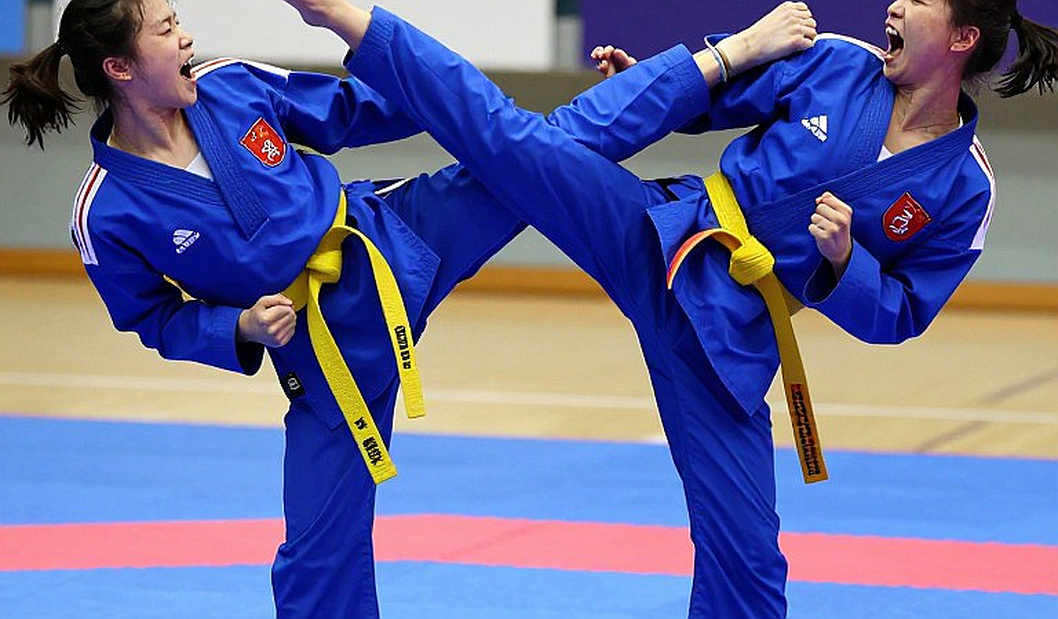
In a fight, a mistake can be compensated by a counter. In team kata, no counter saves a misaligned shoulder. That is the point I want to stress when reading Vietnam's result: three 5-0 verdicts across three different rounds is evidence of a program refined to standardization, not of a lucky competition day.
Look at the opponent structure. Nepal in the quarterfinals was clearly inferior within the region. Chinese Taipei in the semifinals is a karate nation with depth and a long kata tradition. Iran in the final is a leading continental karate power. A team can only sweep all three of these opponents with an identical vote ratio if its performance quality is far enough ahead that no judge has to hesitate.
What stands out sits elsewhere: round-to-round stability. In team kata, a team usually selects different routines per round as strategy. Holding the same result across three rounds shows the team has more than one routine capable of winning at continental level — a sign of program depth, not of a single signature routine.
In the language I still use on air: this is the player who can switch combos while keeping the same efficiency, rather than living and dying by one single sequence and collapsing once it is read. In fighting games, the highest-tier player is not the one with the longest combo, but the one with many equally viable combos. Team kata operates on exactly that principle.
Between the football pitch and the esports arena there is an invisible bridge, and I make a living proving it is wobbling. This time the bridge did not wobble — it stood firm on one point: the precision of a movement set repeated many times under pressure, something every esports pro and every kata competitor understands identically.
On the physical side, kata is a discipline without weight classes, without weight cuts, without impact trauma. That is a major sports-medicine plus. But do not mistake it for light work. Deep stances, transition steps, jump actions and dynamic tension repeated thousands of times in a training cycle create cumulative load on the knees, ankles and lower back. This is the overuse injury type, silent, absent from the news, surfacing only when an athlete suddenly loses range of motion at twenty-five.
Understanding this shows why the three names in one kata team are a more important fact than the medal itself. A three-person lineup is a fragile structure: replacing one athlete means rebuilding the entire synchronized program, and every title-defense plan in the next cycle depends on keeping exactly those three bodies healthy and still competing.
At the organizational level, kata falls under the governance of the international karate federation, while wushu falls under the international wushu federation. Two martial-arts medals on the same competition day are two separate governance systems, not one unified "martial arts" bloc. Any comparison of the form "this delegation is strong in martial arts" is structurally wrong.
Contrarian angle: the brightest medal may be the biggest warning
There is an easy temptation: to read the women's team kata gold as proof that Vietnam's martial-arts program is at a comprehensive peak. I do not believe that.
Set two events side by side. On one hand, the women's team kata squad won three matches by unanimous vote. On the other, the mixed team shooting pair had enough points for the final but were eliminated for a uniform fault. These two events speak to different things but point at one: the operating quality of a sports delegation does not lie in its peak achievements, but in the thickness of its detail control.
A performance gold can come from the talent and grinding work of three people. A lost final berth due to a uniform fault does not come from talent — it comes from process. And process is the only thing that can be replicated across an entire delegation, while talent cannot.
Read that way, the kata gold is good news for the individuals and the discipline, but not necessarily for the system. A strong sporting nation is not measured by the number of flags raised on one floor, but by the number of times nobody has to raise a flag at the inspection desk.
It is also worth saying plainly that kata as a medal pathway, compared with weight-class contact disciplines, carries lower injury risk, lower sports-medicine cost, and less dependence on draw luck. That is why smaller sporting nations often invest in performance events before contact events. But precisely for that reason, kata easily becomes a comfort zone that makes people forget that the real strength of a martial-arts nation lies in its capacity to produce contact fighters. A strong kata squad does not compensate for a lost generation of sanda.
And here is where I see the data beginning to resist. When data begins to resist, tactics finally speak. We are told the team won 5-0, but not which kata was selected in each round, with no component scores, no information on the ages and training budgets of the three athletes. A result without baseline data feeds emotion only, not strategy.
The 2026 rebellion taught me one thing: fear the number that does not know how to lie. But it also taught me the reverse — fear more those results that have no number at all to lie with.
An unclosed conclusion
The women's team kata gold at Asiad 20 deserves full recognition: three matches, three unanimous vote ratios, a defended title, and a first gold that opened the delegation's account. Purely on technical merit, this is the mark of a program with genuine depth.
But if I were allowed to keep just one line to track through the next cycle, I would not keep the medal line. I would keep the line about the three-person lineup: are they still intact, has anyone suffered a knee injury, is a young athlete being pushed up to share the load. Because a performance medal can be repeated with the same three people, while a sporting nation can only be repeated by the next generation.
When the stands are empty, I hear the match through data rather than through the heart, and that was the first time I understood the sadness of a passage of play. This time the stands were not empty, the cheers were real, and the fifth flag rose decisively. I still want to hear one more number before calling it dominance.